
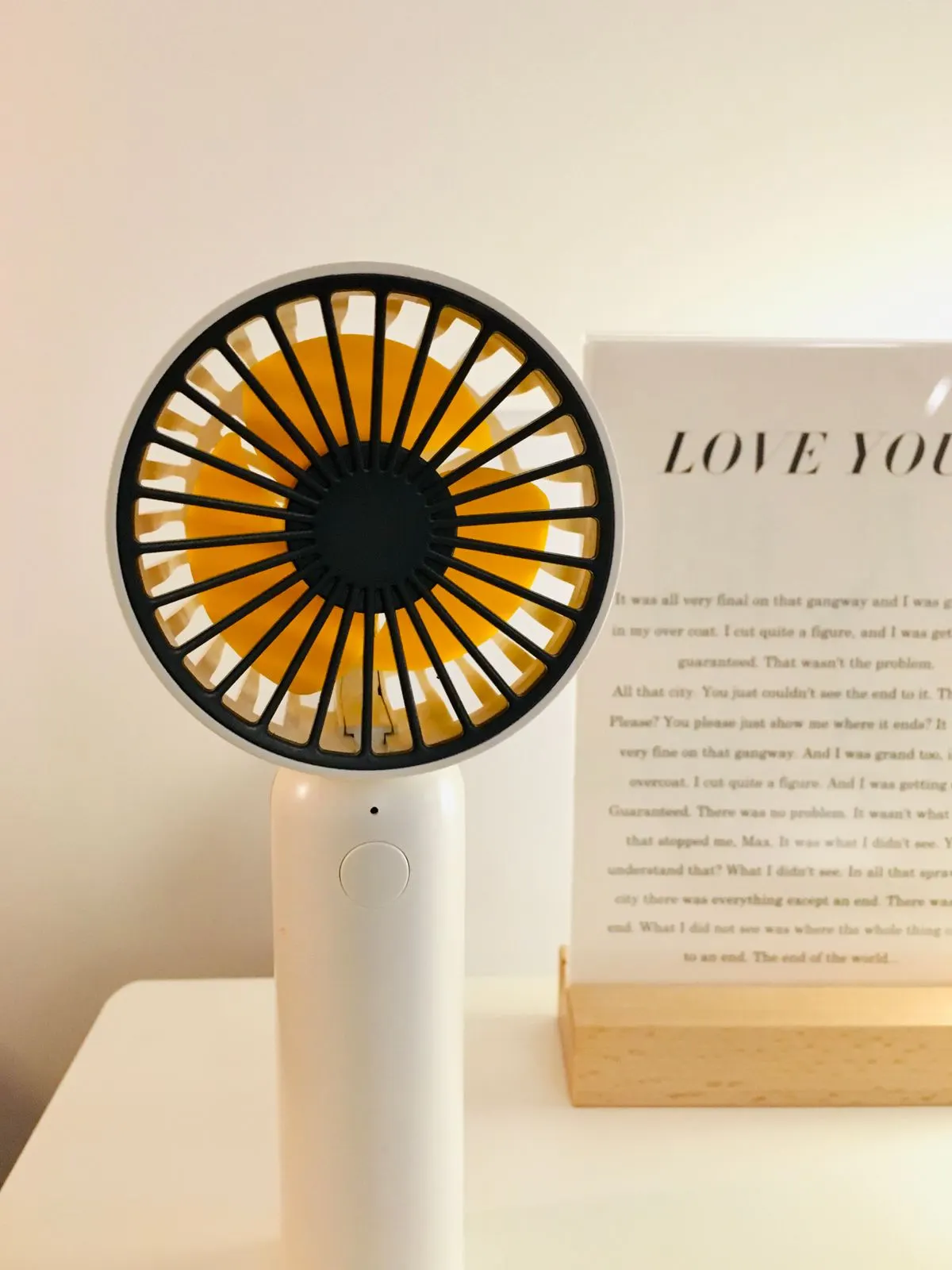
Short answer
A portable air cooler is an evaporative device — it cools by wet-pad evaporation and works only in dry climates (under about 50% humidity). A portable AC is real refrigeration, works anywhere, but needs a vent hose to a window. In humid weather, the AC is the only one that actually cools a room.
Heads-up: some product links below are affiliate links. If you buy through one, Vitherma may earn a small commission at no cost to you — and I only link to gear I'd point a friend to.
Two years ago I bought a "ventless portable AC" online because I lived in a rental where I couldn't drill a window kit. It arrived, I set it up, and the room stayed exactly as hot as before. I moved the box down to the basement, embarrassed, and started researching what I had actually bought. Answer: an evaporative cooler with a marketing team.
Since then I've owned both categories — the real portable AC, the evaporative cooler, and one of the tower fans that people sometimes confuse with both. Here's the honest comparison, without the store-shelf confusion. If you want the winter counterpart of this decision, the pillar guide covers heater sizing in the same voice, and the overnight-safety guide is what to check before running any of this at night.
How does each one actually cool a room?
They cool by two totally different physics. That's the reason they behave so differently — not the price, not the brand.
Evaporative cooler (air cooler, "swamp cooler")
Water sits in a tank. A pump wets a pad. A fan blows room air through the wet pad. Water evaporates. Evaporation absorbs heat from the air. Cool, humidified air comes out the front. The U.S. Department of Energy's home-cooling guide (PDF) notes that an evaporative cooler can be a cost-effective option in an arid climate and is only suitable for areas with low humidity.
The magic works only when the air is dry enough to accept more water. If the air already carries a lot of moisture, evaporation slows down and you just push warm, damp air around the room.
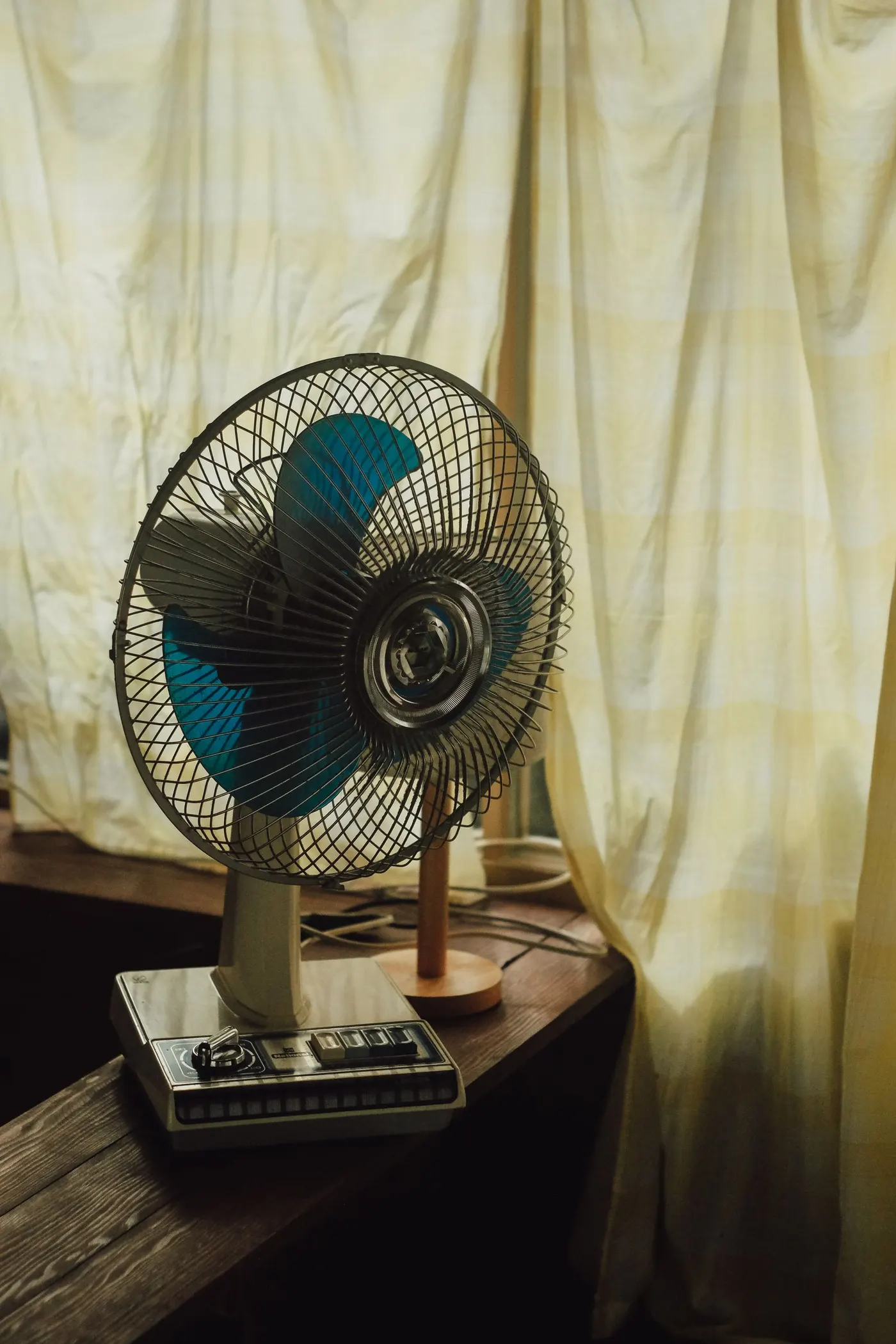
Portable air conditioner
Same refrigeration cycle as a window AC or a car AC — a compressor pressurizes refrigerant, the refrigerant absorbs heat from indoor air, then releases that heat outside. "Outside" is where the vent hose comes in: it must exit through a window or wall, otherwise the machine is just moving heat from one side of itself to the other.
Works in any humidity, any climate, at any indoor temperature humans normally live in.
What's the humidity rule that decides between them?
The simple version: check your local relative humidity on a hot afternoon.
- Under 40% humidity (Phoenix, Las Vegas, Denver, most of Spain's interior): an evaporative cooler is fantastic. Real cooling, low electricity use, and the added moisture is welcome in dry air.
- 40% to 55% humidity: evaporative works, but less dramatically. You'll drop the room a few degrees. Fine for a garage or a workshop, marginal for a bedroom.
- Over 55% humidity (Miami, Houston, coastal Brazil, most of the U.S. Southeast, most of Southeast Asia, coastal Southern Europe in August): don't buy an evaporative cooler. You need a portable AC or a window unit.
This is the single most misunderstood thing about portable cooling. In a store, both boxes say "up to 20°F cooler" or something similar, and both are technically telling the truth — in the right climate. They fail to mention that "the right climate" for an evaporative cooler is roughly the western half of the U.S. and very little of the southeastern half.
What about electricity — which uses less?
Not close. An evaporative cooler is basically a big fan with a water pump — 100 to 200 watts. A portable AC is a real refrigerator: 900 to 1400 watts, sometimes more on higher-BTU models.
Rough math at $0.16/kWh, 8 hours a day:
- Evaporative cooler: 0.15 kW × 8 × $0.16 = about $0.19/day, or $6 a month.
- Portable AC: 1.1 kW × 8 × $0.16 = about $1.41/day, or $42 a month.
If you're in a dry climate and the evaporative cooler will actually work, the running cost is roughly seven times lower. If you're in a humid climate, though, this comparison is meaningless — the cooler won't cool, so cost-per-hour of running a machine that doesn't do its job is infinite.
Setup, portability and noise
Two more things that don't get enough attention.
Setup: an evaporative cooler you unbox, fill with water, plug in, done. A portable AC needs a window kit installed — usually a plastic panel that expands to fit a sliding window plus a large flexible hose. In a rental with weird windows, that installation goes from "twenty minutes" to "actually not possible."
Portability: both are on wheels, but a full portable AC weighs 60–75 pounds and drags a big hose. Moving it from the living room to the bedroom is a project. An evaporative cooler is 15–25 pounds and moves like a fan.
Noise: at low speed, both hover around 48–52 dB — audible but not disturbing. At high, both climb to 58–65 dB, which is loud enough that many people put them in a different room and rely on the door being open. If bedroom silence matters, the honest recommendation is a small window AC or a mini-split rather than either portable. The noise measurements section of the pillar guide has my measured numbers for the winter side, and they follow the same pattern.
How do you install the vent hose for a portable AC?
The hose install is what makes or breaks a portable AC in a rental — or in any home with unusual windows. Here's what nobody explains in the box.
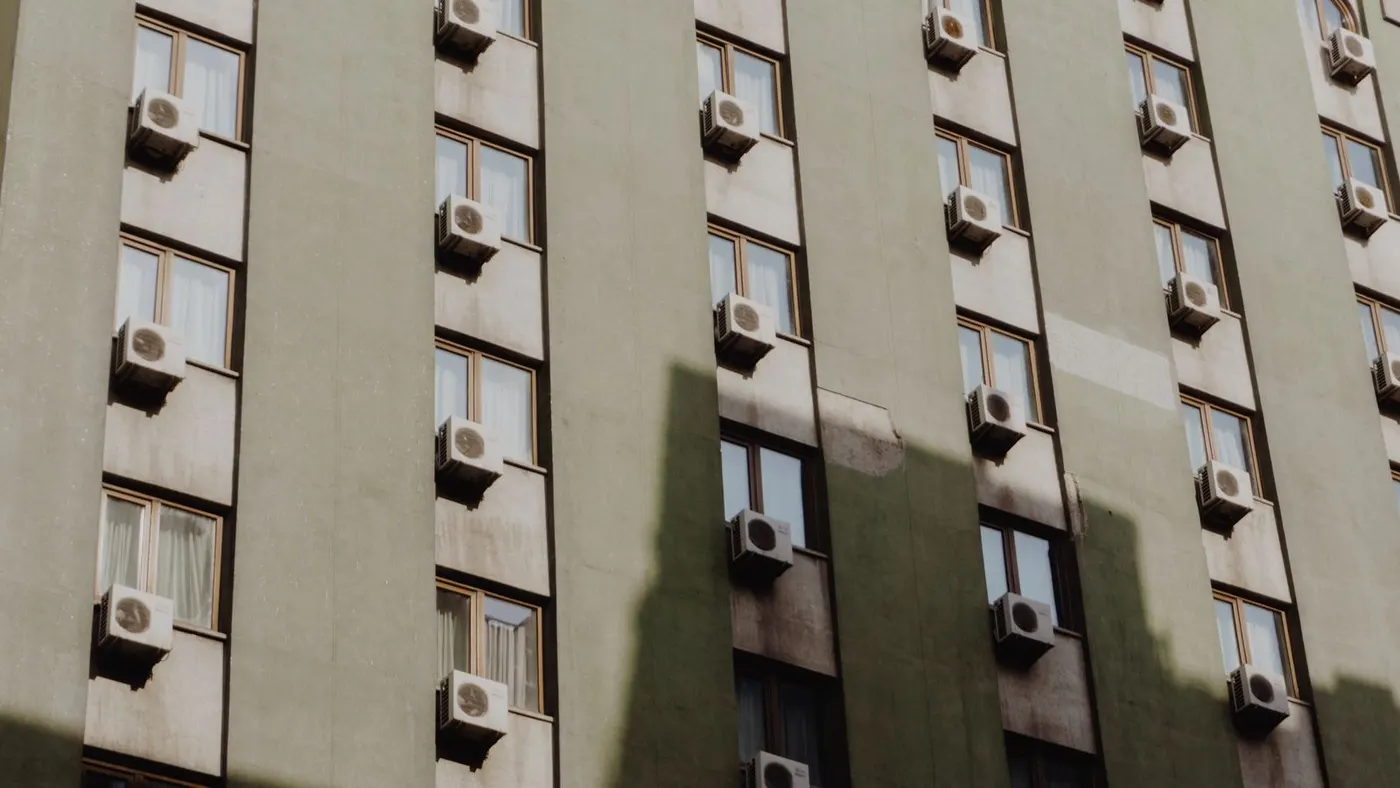
Standard sliding sash window (most of the U.S., most of the U.K.). The kit is designed for exactly this window. Slide the sash open, extend the plastic panel to fill the gap, tighten the screws, connect the hose to the panel's port on one end and the AC on the other. Total install time: about 20 minutes the first time, 5 minutes each season after.
Casement window (crank-open). The stock kit doesn't fit. You need an aftermarket casement window kit — a plexiglass panel cut to the size of the opening, with a matching hose port. About $40–$80 on the aftermarket. The install involves cutting to your exact window dimensions, which some renters can do reversibly and some can't.
Sliding patio door. The stock kit for a tall sliding door is usually included in mid-priced units, or sold as an add-on. The panel is much taller (4–8 ft) and takes up the top of the door opening. The remaining door still opens and closes, so you keep patio access.
Through-the-wall port. The permanent solution. A 5-inch hole through an exterior wall, sleeved and weatherproofed. The AC hose plugs into it year-round. If you own the house and expect to run a portable AC every summer, this is worth the $150–$300 install to a handyman.
Two-hose vs one-hose. Single-hose models pull air out of the room to cool the compressor, which creates negative pressure that pulls hot air back in through window gaps. Dual-hose models pull outside air in through one hose, use it to cool the compressor, and expel it through the other. Dual-hose is genuinely more efficient in real use — worth the extra $150 if you'll run it 8+ hours a day.
Which one wins by region and climate?
After owning both in three houses across two countries, this is the map I'd draw.
Southwest U.S., interior Spain, most of Australia, southern Africa's dry belt. Buy the evaporative cooler. Real cooling, tiny electric bill, added humidity is welcome. My in-laws in Phoenix run one at 150 W and cool a 200 sq ft office by 15°F on a summer afternoon.
U.S. Southeast, coastal Brazil, Southeast Asia, Gulf states, monsoon India. Buy the portable AC (or a window unit if you can). The evaporative cooler will make the room worse, not better — the extra moisture in already-heavy air feels like walking into a laundromat. Even a small window AC beats the biggest evaporative cooler in this climate.
U.S. Midwest, U.K., Northern Europe, most of Canada. Honestly, a good fan does 80% of the job for 90% of the season, and the portable AC comes out for 2–3 weeks a year. A window unit sitting in a closet the rest of the year, mounted only during the July heatwave, may make more sense than either portable. If the same room becomes a winter bedroom, the same investment logic applies in reverse — the overnight-safety guide is the piece to read before December.
Coastal California. The ocean air keeps humidity in the middle of the range, and the true hot days are rare. A fan and an evaporative cooler for the handful of high-temperature-low-humidity days that do come is often enough.
Australia's east coast, coastal Portugal, coastal Turkey. Middle case again. The evaporative cooler works some days and disappoints others. If budget only allows one, the portable AC handles both dry and humid; the evaporative cooler doesn't.
What about hybrid units and "swamp-plus-fan" combos?
A category I mostly avoid: the "hybrid" portable that claims to be both an evaporative cooler and an air conditioner. The listings show two settings, one wet, one dry. In practice they're evaporative coolers with a marketing sticker for the fan-only mode. If a "portable AC" weighs 30 lbs and doesn't have a hose, it's not doing refrigeration. Real portable ACs weigh 60 lbs and up because the compressor is heavy.
There is one exception: some genuine dual-hose portable ACs from established brands include a supplemental evaporative pre-cooler in the outside-air intake. That improves the AC's efficiency in dry climates by 5–10%. It's a real feature, not a marketing one — but it doesn't replace refrigeration. If you see it advertised on a $200 unit, it isn't real; on a $700 dual-hose unit, it usually is.
How do you actually measure the humidity in your room?

You don't need special equipment. A $10 hygrometer from any hardware store gives you a real reading in under a minute. Set it on the nightstand, wait 30 minutes for it to stabilize, note the number.
If it reads under 40%, an evaporative cooler will thrive. Between 40% and 55%, evaporative works but underwhelmingly — a fan may be enough. Over 55%, a portable AC is the only option that will actually cool a closed room.
Do the reading at 3 pm on the hottest day of the summer, not at 9 am — that's the number that matters. Most weather apps also show "humidity" but they report outdoor humidity; indoor humidity in a closed room can be different by 15–20 points depending on ventilation, plants, laundry drying, cooking, and whether the AC has been running. Buy the machine that fits the indoor number, not the app number.
So what about the "ventless portable AC" I keep seeing online?
They're evaporative coolers. The name has been stretched to the breaking point by marketing, but there is no way to run a compressor-based air conditioner without expelling heat somewhere — the physics doesn't allow it. If a "portable AC" listing shows no window kit in the box and no hose in the pictures, it's an evaporative cooler.
That's not necessarily bad — in a dry climate, an evaporative cooler is exactly what you want. It's just not what "AC" traditionally means, and buying one thinking it will cool a humid Miami bedroom will disappoint you the same way it disappointed me.
The one-line decision
Look up your typical summer humidity. Under 50% — buy the air cooler and enjoy the low bill. Over 55% — buy the portable AC, install the window kit, and enjoy an actually cool room. Right in between — a good fan plus the evaporative cooler on the hottest days is often enough, and cheaper than either category done wrong.
For the full framework on how portable cooling fits with heating decisions and room sizing, the pillar guide covers both seasons in one place. And if the same room becomes a winter bedroom that runs a heater overnight, the overnight-safety guide is what to check before December.
Frequently asked questions
What is the difference between a portable air cooler and a portable air conditioner?
An air cooler is evaporative — it cools by blowing air through a wet pad. A portable air conditioner uses refrigerant like any AC, works in any climate, but needs a vent hose to a window.
Do evaporative coolers work in humid weather?
They work best under about 50% relative humidity. Above 60%, they add moisture to already-heavy air without meaningfully lowering the temperature.
Can a portable AC really be ventless?
No. A real refrigeration cycle must expel heat somewhere. Devices sold as "ventless portable AC" are almost always evaporative coolers rebranded.
Which one uses less electricity?
Evaporative coolers pull about 100–200 watts. Portable ACs pull 900–1400 watts. In a dry climate the cooler wins on cost by roughly seven times.
Can a portable AC also heat a room in winter?
Some higher-end portable ACs include a heat-pump mode that reverses the refrigeration cycle to bring warm air indoors, and it works down to about 45°F outdoors. Below that they fall back to an electric-resistance heater built into the unit — which is the same as running any 1500 W space heater and costs the same to operate.