

Short answer
For a side sleeper, a pillow has one job: fill the gap between the side of your head and the outside of your shoulder so your neck stays in line with your spine. Four things decide whether it does that — loft, shoulder clearance, how the surface holds heat, and whether it keeps its shape all night. Everything else is decoration.
Heads-up: some product links below are affiliate links. If you buy through one, Vitherma may earn a small commission at no extra cost to you. It never changes what I recommend or what I flag as a downside.
This site started with heaters and coolers, because the first thing I ever fixed in my own house was the temperature. The bedroom is where that project ran out of road. I could get the room to exactly the number I wanted and still wake up at three in the morning with a dead arm and a crease across my cheek.
The problem was never the thermostat. It was the pillow — the cheapest object in the bed, the one nobody researches, and the one your head spends a third of your life on.
This is the guide I wish I had read first. It is written for side sleepers specifically, because side sleeping is the position that punishes a bad pillow hardest, and because most pillow marketing is written as if everybody sleeps flat on their back like a diagram.
Why does a pillow matter more if you sleep on your side?
Because of geometry, not comfort. When you lie on your back, the distance between the mattress and the back of your head is small — a couple of centimetres of soft anything usually works. When you roll onto your side, that distance jumps to the width of your shoulder.
Suddenly you need a pillow that fills a gap the size of your shoulder without pushing your head higher than that. Too thin and your head drops toward the mattress, bending your neck downward. Too thick and it props your head up, bending your neck the other way. Both feel fine for twenty minutes and awful by morning.
That is why side sleepers are the ones who flip the pillow, fold it in half, stack a second one on top, then pull it out again at 3 a.m. You are not fussy. You are trying to solve a measurement problem with a rectangle that was not measured for you.
Fragmented sleep is worth taking seriously. The NIH's neurological institute notes that most adults need 7 to 9 hours of sleep a night, and that REM sleep does not even begin until roughly 90 minutes after you fall asleep. If something pulls you out of sleep every ninety minutes, you can be in bed for eight hours and still be short on the part that matters. The NHLBI's overview of sleep deprivation and deficiency makes the same point: it is not only about total hours, it is about sleep that is continuous and at the right time.
What is the shoulder gap, and why does it decide everything?
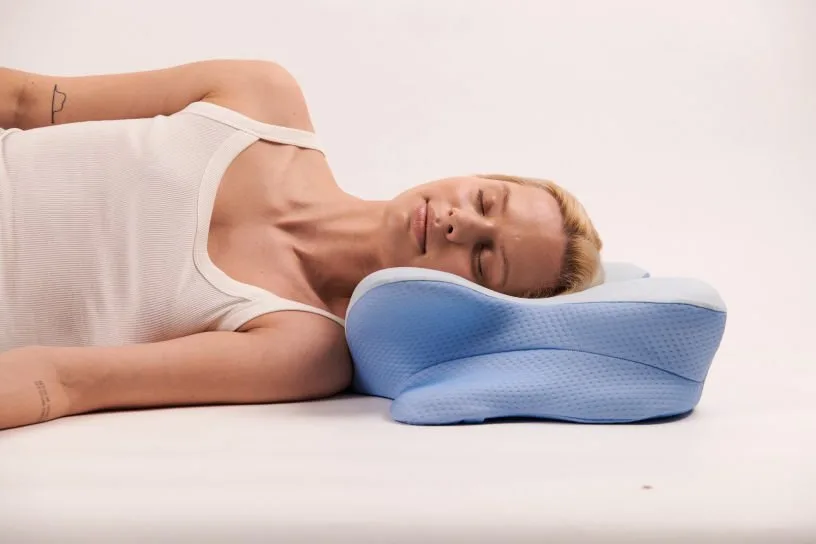
Lie on your side on a flat surface with no pillow and look at the triangle formed by your head, your neck and the mattress. That triangle is the shoulder gap. Fill it exactly and your head floats level with your spine. Fill it badly and every muscle along the side of your neck spends the night holding your head up.
Three things change the size of that gap, and none of them are printed on a pillow's packaging:
- Your shoulder width. Broad shoulders need meaningfully more loft than narrow ones. This is the single biggest reason the same pillow gets five-star and one-star reviews from honest people.
- Your mattress firmness. On a soft mattress your shoulder sinks in, which shrinks the gap. The same pillow that is perfect on a firm mattress will be too tall on a plush one.
- Whether the pillow lets the shoulder in at all. A plain rectangle sits under your head and your shoulder has to squash up against its edge. A pillow with cut-away sides gives the shoulder its own space.
That last point is the whole argument for contoured pillows, and it is worth understanding before you look at a single product page.
How high should a side sleeper's pillow be?
There is no universal number, and any brand giving you one is guessing. What there is, is a test you can do tonight, for free.
Lie on your side in your normal sleeping position and have someone look at you from the front. Two things should be true. Your nose should line up roughly with the middle of your chest, not angled up at the ceiling or down at your knees. And the line of your neck should continue the line of your spine, without a visible kink where your head meets your shoulders.
If your head is tilted up, the pillow is too tall. If it is drooping down toward the mattress, it is too thin. Take a photo if you live alone — you will see it instantly in a picture in a way you cannot feel from the inside.
One more sign worth learning: if you wake up with a numb arm or a dead shoulder, that is usually not the pillow being too low. It is your shoulder being crushed because it has nowhere to go. That is a shape problem, not a height problem, and adding another pillow underneath makes it worse.
Are contoured butterfly pillows better than flat ones?
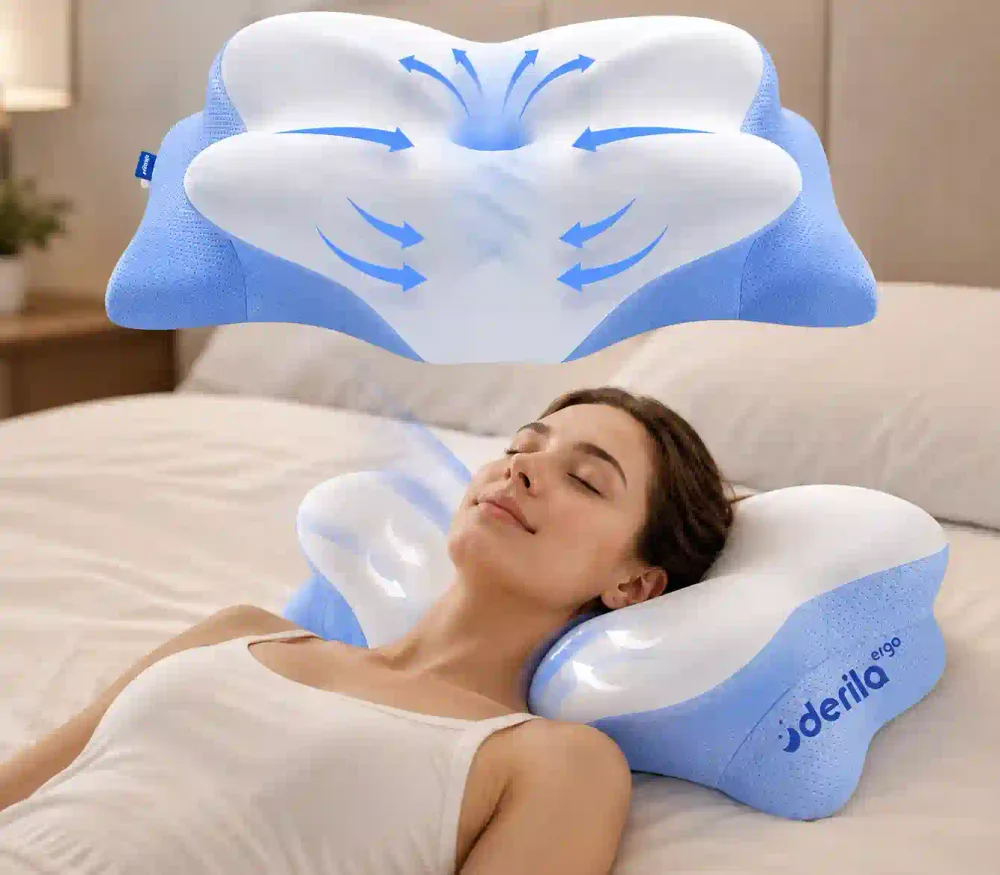
For a side sleeper, a contoured pillow is trying to do three things a rectangle cannot.
It gives the shoulder a channel. The cut-away sides of a butterfly shape are not styling. They are the gap your shoulder and upper arm slide into, which is what keeps your head level rather than propped.
It holds the edges up. Because the wings stay higher than the centre, your cheek and jaw are not pressed flat into the surface for hours. If you have ever woken up with a sleep crease across your face or a numb ear, that is the pressure a raised edge is meant to spread.
It fills the neck. The lower lip at the front sits under the curve of your neck — the space a flat pillow leaves completely empty. That is the part people notice on the first night, usually as "this feels strange."
Now the honest trade-offs, because contour pillows have real ones.
- You cannot adjust a fixed shape. A down pillow can be punched, folded and re-stuffed. A moulded foam contour is the height it is. If that height is wrong for your shoulders, nothing will fix it.
- They feel wrong before they feel right. Three to seven nights is normal. Some people never get past it, which is exactly why a money-back window matters more on this kind of pillow than on any other.
- They are mostly wasted on stomach sleepers. Face down, a raised contour is in the way. If that is your main position, a thin flat pillow serves you better.
- They look small on a made bed. Most contour pillows are deliberately narrower and lower than standard, which means they swim inside a normal pillowcase and do not match the rest of your bedding.
If you want to see how one specific pillow handles all four of those trade-offs, I took one apart in detail in my Derila Ergo review — including the parts the producer itself lists as downsides, and one thing about its guarantee that does not add up between its own official pages.
Does memory foam make you sleep hot?

Denser foam holds heat. That is not a marketing failure, it is physics: the denser the material, the less air moves through it, and your head puts out a surprising amount of warmth all night.
Manufacturers attack this in three ways, and all three do something real without solving it outright. Open-knit covers let warm air out instead of sealing it in. Moulded channels or perforations in the foam create paths for air to move. Gel infusions slow down how fast the surface warms up, though they do not keep working for eight hours.
So treat "cooling memory foam" as "cooler than plain memory foam," not as "cool." If you want genuinely cool, down, latex and buckwheat all breathe better than foam does, and they give up the contour to get there.
Here is where my thermostat obsession earns its keep: if you are waking up hot, the room is almost always the bigger lever than the pillow. A bedroom two degrees cooler does more for sleep continuity than any pillow cover. If your problem is summer heat, I compared the two machines people usually confuse in portable air cooler vs portable AC, and the rule about humid versus dry climates changes the answer entirely. If it is winter and the issue is a cold bedroom rather than a hot one, the portable heater guide covers sizing by room, and what a heater really costs per hour covers what running one overnight actually does to your bill.
What about snoring and sleep position?
Pillows get marketed as anti-snoring devices, and the mechanism behind that claim is real but narrow. When your head tips too far forward or too far back, the airway narrows. A pillow that keeps your head in a neutral position keeps the airway a little more open. For snoring that is clearly positional — worse on your back, better on your side — a better-shaped pillow can genuinely make a difference.
What it cannot do is treat a medical condition. Snoring that happens every night, is loud enough to be heard through a wall, comes with gasping or pauses in breathing, or leaves you exhausted during the day, is worth raising with a doctor. The NHLBI's page on sleep apnea describes what those signs can point to and why they need a real diagnosis. No pillow, contour or otherwise, is a substitute for that conversation.
The same goes for pain. If you wake with neck or shoulder pain that persists through the day, or that wakes you at the same hour every night, a better pillow is worth trying and a clinician is worth seeing. Bedding is comfort equipment, not treatment.
What are the most common side-sleeper pillow mistakes?
These are the ones I made myself, in roughly this order.
- Stacking two pillows. It seems to solve the too-thin problem. What it actually does is lift your head far past level and put a hinge in your neck. If one pillow is too thin, replace it — do not add a second.
- Buying by firmness instead of height. "Firm" and "tall" are not the same thing. A firm low pillow and a soft tall pillow put your head in completely different places.
- Ignoring the mattress. Changing your mattress changes the right pillow. If you bought a softer bed and your neck got worse, the pillow you kept is now too tall.
- Keeping a dead pillow because it looks fine. Fold a synthetic pillow in half. If it stays folded instead of springing back, it stopped supporting anything a while ago. Foam pillows are sneakier — they keep their outline but go soft, so the sign is your head tipping even though the pillow looks new.
- Judging a contour pillow on night one. Every contour feels wrong at first because it moves your head somewhere new. Give it a week, inside whatever return window you have.
- Fixing the pillow when the problem is the room. Heat, noise, light and, in my house, a dog who reacts to every car door on the street. If something outside the bed is waking you, the pillow was never the variable — the handheld trainer versus anti-bark collar comparison was written for exactly that 3 a.m. problem.
Which pillow should you actually buy?
Match the shape to how you sleep, then let price be the last question rather than the first.
- Mostly side, wake up with a crushed shoulder or a numb arm: a contoured pillow with cut-away wings. The shoulder channel is the feature you are paying for. This is the category the Derila Ergo sits in, and it is the shape I would try first for that specific complaint.
- Side and back in roughly equal amounts: a medium-loft pillow with a shaped neck edge. You want enough height for the side and enough give that lying back does not push your chin toward your chest.
- Mostly back: lower loft with neck support. The gap you are filling is small, and anything tall tips your head forward.
- Mostly stomach: the thinnest pillow you can tolerate, or none. Contours will only annoy you.
- You run hot above everything else: prioritise breathability over shape. Latex or a well-ventilated cover, and fix the room temperature first.
One last practical note that applies to every option above: buy where you can send it back. A pillow is the one piece of bedding you genuinely cannot evaluate in a shop, because the thing you are testing is what your neck feels like after seven hours, not after seven seconds. Whatever you choose, check the refund window before you pay, and put a note in your calendar a few days before it closes.
Frequently asked questions
How high should a pillow be for a side sleeper?
High enough to fill the distance between the side of your head and the outside of your shoulder, and no higher. Broad shoulders need more loft, narrow shoulders need less, and a soft mattress needs less than a firm one because your shoulder already sinks in. The test is simple: lie on your side and check whether your nose lines up with the middle of your chest.
Are contoured butterfly pillows better for side sleepers?
They solve one real problem well: the cut-out sides give your shoulder somewhere to sit, so your head is not pushed up out of line. The trade-off is that a fixed shape cannot be adjusted, it takes a few nights to get used to, and it does almost nothing for stomach sleepers.
Does memory foam sleep hot?
Denser foam holds more heat than down, latex or buckwheat, because there is less air moving through it. Open-knit covers, moulded channels and perforations all help, but they reduce the problem rather than remove it. If you wake up flipping the pillow to the cool side, the room temperature is usually the bigger lever.
Can changing pillows stop snoring?
Sometimes, for positional snoring, because a head that is tipped forward or backward narrows the airway. It is not a treatment. Loud snoring every night, gasping, or heavy daytime sleepiness should be discussed with a doctor rather than solved with bedding.
How often should you replace a pillow?
When it stops holding your head where it should be. Fold a synthetic pillow in half; if it stays folded instead of springing back, it is done. Foam pillows fail differently — they keep their outline but get softer, so the usable sign is waking with your head tipped even though the pillow looks fine.
Do you need a different pillow if you switch positions at night?
Most people change position several times a night, so the practical answer is to buy for the position you spend the most time in and accept a compromise for the rest. A medium-loft pillow with a shaped neck edge usually handles side and back sleeping better than a flat rectangle does.
Is this medical advice?
No. I test home products; I am not a doctor, a physiotherapist or a sleep clinician. Everything here is about comfort and fit. For persistent neck, shoulder or back pain, or for snoring with daytime exhaustion, please talk to a qualified clinician — see the about page for exactly what I do and do not claim to be.