
Short answer
A hydrogen water bottle is a rechargeable bottle with an electrolysis base: you fill it, press one button and, a few minutes later, you have water with hydrogen gas dissolved in it. Before you buy, check the cycle time, how many runs one charge gives, whether the glass goes in the dishwasher, how the maker states its hydrogen number and what the guarantee covers.
This article may contain affiliate links, always to the official websites of the products mentioned. If you buy through one of these links, you support my work at no additional cost to you. This never influences what I write.

It is mid-afternoon, the glass on your desk has been full since lunch, and plain water has stopped being interesting. A hydrogen water bottle turns that glass into a small routine: fill, press, wait a few minutes, drink. The idea has spread fast, and the boxes and listings are full of numbers that are hard to compare.
This guide keeps to the gadget. It explains how the bottle makes its water, what the numbers mean, what the FDA and one lab study say about the basics, and the checks I would make before paying. The LifeWater, the one hydrogen bottle on this site, shows up near the end as an example of what those checks look like in practice.
What is a hydrogen water bottle?
It is a bottle that makes hydrogen water at home. Medical News Today describes hydrogen water as regular water infused with pressurized hydrogen gas, and notes that it comes from tablets you drop in a glass or from a generator that infuses the water. Healthline adds the third route: cans and pouches filled at the factory.
The bottle is the generator route without the countertop machine. The base holds a battery and the electrodes, the bottle sits on top, and a USB cable recharges the base.
On the health side, Medical News Today says research into the effects of hydrogen water is still in its early stages. That is one more reason I judge a bottle on things I can check at home: how easy it is to use, how it is built and what the maker puts in writing.
How does a hydrogen water bottle work?
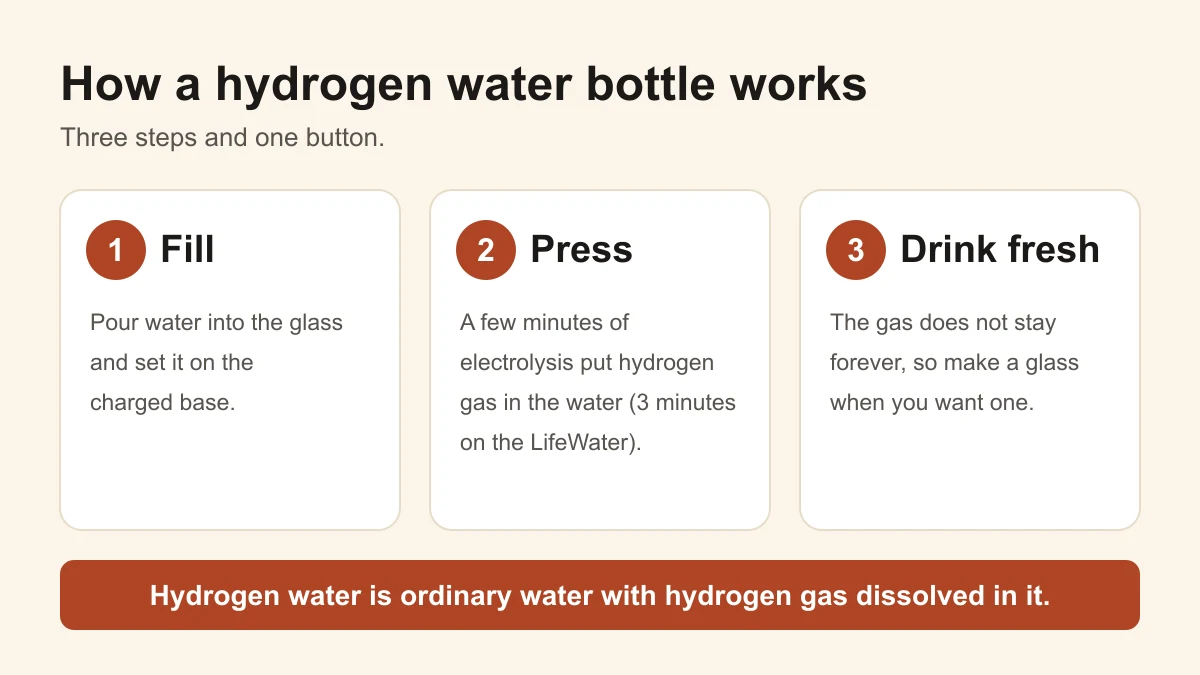
Through electrolysis. A small electric current runs through the water in the base and splits some of it into hydrogen and oxygen. The hydrogen dissolves into the water in the bottle, and that is the hydrogen water. The whole cycle usually takes a few minutes.
What happens inside the base differs from bottle to bottle. Some makers describe a solid polymer electrolyte membrane, called SPE or PEM, between the electrodes. The LifeWater's producer describes its bottle as using SPE electrolysis. A 2021 study of an electrolytic bottle from Japan, on the other hand, tested a single-tank design with no membrane separating the electrodes. So the letters on the box are a good question to ask the maker, and a design detail, not a ranking.
What does the hydrogen number on the box mean?
It is the amount of hydrogen dissolved in the water after a cycle, usually written in ppm or ppb (parts per million or per billion). One ppm equals one milligram per liter. Healthline notes that there is no industry-wide standard for how much hydrogen is added to water, so concentrations vary widely from product to product.
For a sense of scale, the Japanese study measured one bottle, a single-tank model, after a 10-minute cycle on 330 milliliters of tap water. It found 444 micrograms per liter of hydrogen, which is about 0.44 ppm. That is one bottle in one lab. It does not tell you what any other bottle makes.
What it does tell you is what to look for on a box: the number, the cycle time and the volume of water it applies to. A number without those three is half an answer.
How long does the hydrogen stay in the water?
Not for long, so it is best made fresh. Hydrogen is a gas, and gas leaves water that sits in an open glass. None of the sources I read gives a time in minutes. Healthline passes along the advice from experts to choose non-permeable containers and to drink the water quickly.
That is why the bottle format works well: you make a glass when you want one, and you drink it fresh. A one-button cycle of about three minutes fits that habit better than a stack of cans in the pantry.
Is hydrogen water safe to drink?
Two things are worth knowing, and I will keep them in their place.
First, the gas itself. Medical News Today points to the FDA's GRAS inventory: a 2014 notice, GRN 520, covers hydrogen gas as an ingredient in drinking water, flavored beverages and soda at up to 2.14% by volume, and the FDA responded that it had no questions. That notice is about hydrogen as an ingredient. It says nothing about any particular bottle.
Second, the electrolysis. Splitting water with electricity can in theory create small amounts of chlorine or ozone, depending on the water and the electrodes. In the 2021 study (Hatae and Miwa, Medical Gas Research), ozone was not detected in that bottle's water and chlorine did not rise. The authors tested one bottle, a small number of runs, and they recommend measuring before and after electrolysis. Treat it as a reassuring data point and as a reason to ask any maker whether it publishes its own test results.
Which seven checks matter before you pay for one?
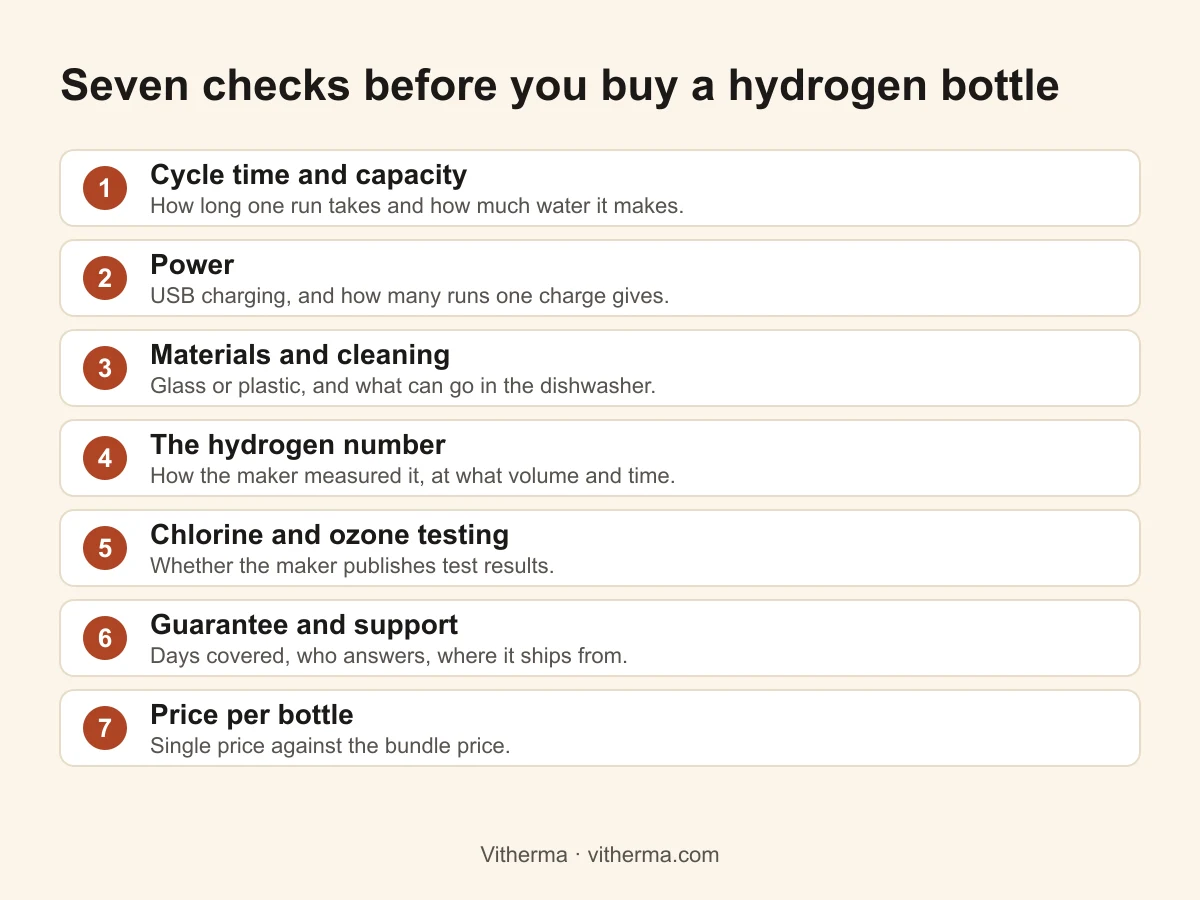
- Cycle time and capacity. How long one run takes and how many ounces it makes. A short cycle and a full glass per run suit a desk or a kitchen counter.
- Power. Rechargeable over USB is the easy kind. Ask how many runs one charge gives and whether the cable and plug are in the box.
- Materials and cleaning. A glass body is simple to clean. Check what can go in the dishwasher and whether the base can get wet.
- The hydrogen number. Look for the figure together with the cycle time and the volume of water it refers to.
- Test results. Does the maker publish chlorine and ozone testing? If the page does not say, support can.
- Guarantee and support. How many days you have, whether the money comes back and who answers your questions.
- Price per bottle. Single price against the bundle price, since a second bottle for the office or a gift is often much cheaper.
Buy from the producer's own website when you can. You get the current offer, the guarantee as the producer wrote it and the support that goes with it.
Where does the LifeWater fit?
It is the one hydrogen bottle I cover on this site, and it ticks the checks that are easy to read from the official pages. It is a glass bottle on a rechargeable base with a one-touch, three-minute cycle and a 14.2 fl oz capacity. A full charge covers 15 to 20 uses, the USB cable and plug come in the box, and the producer notes there are no filters to replace.
Cleanup is quick: the glass goes in the dishwasher and you wipe the base, which is not waterproof. In the United States one bottle is $79.95 and the price drops to $49.95 a bottle in the four-pack. Every order from the official website has a 30-day money-back guarantee, orders ship within 48 hours with a tracking number, and the producer lists 24/7 customer support, so questions about the numbers have a place to go.
My full LifeWater review has the scene-by-scene day, the pros and cons, every bundle price and how I scored it.
If you like fitting small gadgets into the kitchen routine, my home and kitchen gadgets guide covers more for the counter, and the SavourFresh and Ozoori reviews are two other rechargeable ones, with a how-it-works guide to cordless vacuum sealers for the first. The same habit applies to the kitchen board: how to choose a cutting board and how to wash fruits and vegetables follow the same source-first method.
Frequently asked questions
How does a hydrogen water bottle work?
You fill the glass, set it on the base and press a button. A small electric current splits some of the water into hydrogen and oxygen, and the hydrogen dissolves into the water. A cycle usually takes a few minutes, and three on the LifeWater.
Is hydrogen water safe to drink?
The FDA's GRAS inventory lists hydrogen gas as an ingredient in drinking water at up to 2.14% by volume (GRN 520, 2014, with no questions from the FDA). That covers the gas, not any specific bottle, so check what the maker publishes about its own testing.
How long does the hydrogen stay in the water?
Hydrogen is a gas and leaves water that sits open, so the usual advice is to drink the water soon after the cycle. Healthline passes along expert advice to use non-permeable containers and drink it quickly.
What does ppm mean on a hydrogen bottle?
Parts per million of dissolved hydrogen; one ppm equals one milligram per liter. There is no industry-wide standard for the amount, so look for the number together with the cycle time and the volume of water it applies to.
Do hydrogen water bottles need a membrane?
Designs differ. Some makers describe an SPE or PEM membrane, and a 2021 lab study tested a single-tank bottle without one. A membrane is a design detail to ask about, not a ranking by itself.
Can you put a hydrogen water bottle in the dishwasher?
Only the glass part, and only if the maker says so. On the LifeWater the glass goes in the dishwasher and the base, which is not waterproof, is wiped clean.
Is a hydrogen water bottle worth buying?
If you want a simple routine for your daily water, a rechargeable bottle with a short cycle and a clear guarantee is an easy way to try it. The LifeWater has a 30-day money-back guarantee on every order from the official website.
Where can I buy the LifeWater?
On the official LifeWater website, which the buttons on this page link to. Ordering there gets you the producer's own bottle, its 30-day guarantee, its customer support and the current bundle prices.
Sources
- Medical News Today: hydrogen water, definition, benefits and more (August 2025)
- Healthline: hydrogen water, miracle drink or overhyped myth?
- Hatae and Miwa (2021), Medical Gas Research: electrolytic hydrogen-generating bottle and chlorine and ozone
- FDA GRAS Notice Inventory: GRN 520, hydrogen gas (2014)