
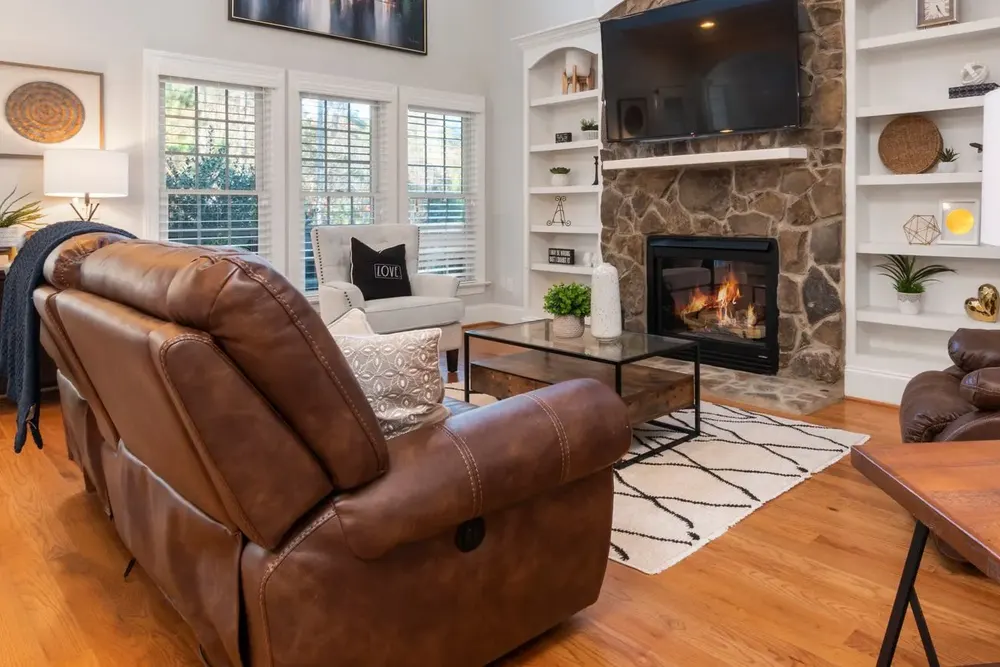
Short answer
Put a space heater on a stable, level surface, with at least 3 feet of clear space on the front, sides and back. Plug it straight into a wall outlet, never into an extension cord or power strip, keep the cord out from under rugs, keep it away from water, and keep children and pets outside that 3-foot zone. Turn it off when you leave the room or go to bed. Those are the rules the U.S. Consumer Product Safety Commission and the National Fire Protection Association repeat every winter.
Heads-up: some product links below are affiliate links. If you buy through one, Vitherma may earn a small commission at no cost to you.
Most heater fires are not caused by a mystery defect. They start with a heater doing its job in the wrong spot: a bedspread that slid down beside it, a curtain that moved in a draft, a power strip that was the only thing within reach of the outlet. Where you put the heater, and what you put around it, decides more than the price tag does. This page walks through the seven placement rules, explains the reason behind each one, and then shows how they change from room to room. If you are still choosing a model, start with the safety section of the pillar guide, and if your question is about sleeping with a heater on, the overnight safety guide covers that one directly.
Why does placement matter more than which heater you buy?
Because the heater is only dangerous next to something that can burn, and you control what is next to it. The Consumer Product Safety Commission (CPSC) says portable heaters, including electric space heaters, are involved in an average of 1,600 fires a year, with 70 deaths and 150 injuries, based on 2020 to 2022 data. The U.S. Fire Administration adds a sharper number: in 2017 to 2019, home portable heaters were only 3% of all home heating fires but 41% of the fatal ones.
The reason is in the wattage. The CPSC describes portable electric heaters as high-wattage appliances that can ignite nearby curtains, beds, sofas, paper, clothing and flammable liquids, and it warns that a heater left on and unattended can turn into a major fire. A heater with every safety feature still gives off the same heat. The features help when something goes wrong, and placement keeps most things from going wrong at all.
Timing matters too. The NFPA notes that half of home heating fires are reported in December, January and February, the months when a heater goes from the closet to the bedroom and nobody has thought about the layout of the room in a year. The best time to read this is before the first cold night, while there is still time to move a couch.
What are the 7 rules at a glance?
| # | Rule | What it means in a real room |
|---|---|---|
| 1 | 3 feet clear | Nothing that burns within 3 feet of the front, sides or back |
| 2 | Stable, level surface | Where it cannot be knocked over, and not on a bed, sofa or chair |
| 3 | Straight into the wall | No extension cord, no power strip, and a plug that fits tightly |
| 4 | Cord in plain sight | Never under a rug, and check plug, cord and outlet for heat |
| 5 | Away from water | Not near sinks or tubs, and never touch it with wet hands |
| 6 | Kid-free zone | Children (and pets) stay outside the 3-foot zone |
| 7 | Never unattended | Off when you leave the room or go to bed |
Rule 1: How far should a space heater be from furniture and curtains?
At least 3 feet, measured from the front, both sides and the back. The CPSC's wording is to keep beds, sofas, curtains, papers and clothes at least 3 feet from the front, sides and rear of the heater. The NFPA gives the same 3 feet for anything that can burn near any heating equipment. Two agencies, one number, and it is the number to remember.
Three feet is farther than it sounds. A standard yardstick is exactly 3 feet, so lay one on the floor in front of the heater and look at what is inside that space. Most rooms fail this test the first time, because heaters get put where the outlet is, and outlets are usually behind a couch, beside a bed or under a window with a long curtain. The fix is almost never the heater. It is moving the furniture, or picking a different wall.

Three things get missed most often:
- Curtains. A curtain hangs straight until a draft or an open window moves it. Under a window is a natural spot for a heater, so check where the curtain ends up on a windy day, not where it hangs on a calm one.
- Soft things that move. Blankets, throws, clothes on a chair and a pile of laundry all shift. If a thing can slide, fall or be dropped toward the heater, treat it as being closer than it looks.
- Papers and wastebaskets. A paper bin beside a desk heater is inside the zone. So are magazines on a side table.
Rule 2: What should a space heater sit on?
A stable, level surface, in a spot where it will not be knocked over. That is the CPSC's wording, and each word does work. Stable means it does not rock. Level means it does not lean. Where it will not be knocked over means out of the path of feet, pets, vacuum cleaners and kids running through.
In practice that rules out a bed, a sofa, a chair cushion, a stack of boxes and a wobbly side table. Most portable heaters are designed to stand on the floor, and your manual tells you whether yours is meant for the floor, a table, or both. Follow the manual first: it is the maker's statement of how the heater was tested and built, and it overrides any general advice on a web page, including this one. One practical note beyond the CPSC's wording: a thick, soft rug can make a small heater sit unevenly, so a flat, firm floor is the easiest way to meet the "stable and level" test.
Also look at the space around the base, not only the heater itself. A heater with a tip-over switch is protected if it falls. It is better still if it has nothing to fall against and nobody who walks past it.
Rule 3: Can a space heater use an extension cord or power strip?
No. The CPSC says to plug electric space heaters directly into a wall outlet and never into an extension cord or power strip. The reason is simple arithmetic. A 1,500-watt heater on a standard 120-volt outlet draws about 12.5 amps (1,500 divided by 120), and a typical household circuit is rated for 15. That is most of the circuit for one appliance, and a thin extension cord or a power strip adds more connections, more resistance and more places for heat to build up.
There is a second half to this rule that people miss: the plug has to fit tightly. The CPSC says if the heater's plug does not fit snugly in the wall outlet, do not use that outlet for the heater. A loose plug makes a poor contact, and a poor contact makes heat right at the wall. The 15-amp circuit section of the small-rooms guide shows how to work out what else is on the same circuit, since a hair dryer or a microwave on the same line adds to the load.
If the only outlet is on the wrong wall, that is a real problem with a boring solution: move the heater's spot, or have an electrician add an outlet. A longer cord is not the answer.
Rule 4: Where should the cord go, and what should you check for heat?
Out in the open, never under a rug or carpet. The CPSC says a cord run under rugs or carpeting can be damaged, which can cause the cord and nearby objects to burn. A cord you cannot see is a cord you cannot check, and it is a cord that gets stepped on, folded and pinched.
Also keep the cord out of the walkway. A cord across a doorway is a trip hazard, and a person who trips on it can pull the heater over. Route it along the wall, with the heater on the outlet's side of the room.
Then check for heat. The CPSC's guidance is to check frequently, during use, whether the plug, cord, wall outlet or faceplate is hot. Its instructions are specific:
- If the plug, the outlet or the faceplate is hot, stop using the heater and have a qualified electrician check or replace the plug or the faulty outlet.
- If the cord is hot, disconnect the heater and have it inspected or repaired by an authorized repair person.
My suggestion for making this a habit: touch the plug and the wall plate after the heater has run for 15 or 20 minutes the first few times you use it each season. Warm is ordinary for a plug under load. Too hot to hold your fingers on is not, so stop and follow the steps above.
Rule 5: Is it safe to use a space heater in a bathroom?
Keep it away from water. The CPSC says to keep electric heaters away from water and never touch one if you are wet, to prevent shocks and electrocutions. A bathroom has all the wrong ingredients together: wet hands, wet floors, steam and outlets close to sinks.
The practical rule is to not place a portable heater in a bathroom unless the maker's manual says the model is designed for that use, and even then to keep it well away from the tub, shower and sink. A cold bathroom is better solved another way: run the heater in the hallway or bedroom beforehand, or use a heater built into the wall. The same goes for a kitchen counter next to a sink, a laundry room with a wet floor, and a basement that floods. Anywhere the floor can be wet, the heater does not belong on it.
Rule 6: How do you keep children and pets away from a space heater?
With a 3-foot kid-free zone. The NFPA recommends a 3-foot "kid-free zone" around open fires and space heaters, and it is the same 3 feet as Rule 1, with people in mind instead of furniture. A heater's grill and housing can get hot enough to burn skin, and a toddler can cross a room in seconds.
The NFPA's wording covers children. Pets are my addition, based on the same reasoning: a dog or cat that curls up beside a warm surface will do it beside a heater too, and a tail or a leash can catch the cord. Treat the 3-foot zone as a rule for them as well.
Ways to hold the zone that work in a real house:
- Put the heater in a corner or against a wall where nobody walks past it.
- Use a piece of furniture, a baby gate or a play yard to keep the space physically blocked, rather than relying on a rule you tell a toddler.
- If you cannot keep children out of the zone, do not run a portable heater in that room. Heat the room another way, or warm it while the room is empty and switch the heater off before anyone comes in.
Rule 7: Should you ever leave a space heater running when you are not there?
No. The CPSC says never to leave a heater operating while unattended or while you are sleeping, and the NFPA says to turn portable heaters off when leaving the room or going to bed. The wording I found in both has no exception for heaters with thermostats, timers or auto shut-off. Those features are there for the day something goes wrong, and none of them turns an unattended heater into an attended one.
That makes the habit simple: leaving the room, switch it off. If you tend to forget, put the heater where you will see it every time you head for the door, so the switch is the last thing you touch on the way out. For the night-time version of this question, including what to do if you decide to run one anyway, the overnight guide has the full answer, and its short version is the CPSC's: turn it off when you sleep.
How do the rules change from room to room?
The rules stay the same. What changes is which one is hardest to keep. These are my own applications of the CPSC and NFPA rules above, not extra official rules.
Bedroom
Rule 1 fails here first. Beds, bedding and curtains are the exact things the CPSC lists, and a bedroom is full of them. Pick a spot along a wall with the whole 3-foot zone clear of the bed, and remember Rule 7: the heater warms the room before bed and goes off when you lie down.
Living room
A living room usually has the most room and the most furniture. The trouble spots are sofas pushed against walls with outlets, throws draped over armchairs and the coffee table that sits exactly 2 feet from the heater. Rule 6 matters most in a family room, where children play on the floor.
Home office or desk
Under-desk heaters break Rule 1 almost by design: your chair, your legs, a paper tray, a wastebasket and a tangle of cables are all inside 3 feet. If you cannot clear that space, it is the wrong spot. A small personal heater on the floor beside the desk, with the zone clear, works better than one buried under it, and it is one you switch off when you get up. Cables are a Rule 3 problem too, since a desk is where the power strips live and the heater cannot use them.
Kids' room
The hardest room to do well, since you need both Rule 6 and Rule 7 to hold. If children are in the room and you cannot keep them outside a 3-foot zone, do not use a portable heater there. Warm the room ahead of time and switch the heater off before they come in.
Garage or workshop
The CPSC lists flammable liquids among the things a portable electric heater can ignite. Gasoline, paint, solvents, aerosol cans and sawdust are all normal in a garage, so the 3-foot zone has to be clear of them, and a heater should never sit near a container of fuel. Many garage-style heaters burn fuel, which is a different safety subject with its own rules: the CPSC says never to refuel a fuel-burning portable heater while it is in use, and to let it cool first.
Rental with one outlet
Renting does not change the rules, but it changes the options. If the only outlet is behind the bed, move the bed, not the cord. The renting section of the overnight guide covers what a tenant can do without permission.
What is the 60-second placement check?
Before you switch on a heater in a new spot, walk through this list. Any "no" means move it.
- Is everything that can burn at least 3 feet from the front, both sides and the back? Use the yardstick.
- Is the heater on a stable, level surface that nobody will kick or brush past?
- Is it plugged directly into the wall, with the plug sitting tightly in the outlet?
- Is the cord visible along its whole length, not under a rug and not across a walkway?
- Are you and the heater dry, and is the spot away from any sink or tub?
- Are children and pets outside the 3-foot zone?
- Will you turn it off when you leave the room or go to bed?
This is general safety information, not a replacement for your heater's manual. If the manual asks for more than this, follow the manual. If a plug, cord or outlet feels hot, or you smell burning, unplug the heater and call an electrician or the maker.
Should you check for recalls and safety certification before you plug it in?
Yes, and it takes two minutes. The CPSC's guidance is to check whether your electric heater has been recalled before you use it, and to inspect the heater, cord and plug for damage each time you bring it out. Look up the model number on the CPSC's recalls page. SaferProducts.gov is the database where consumers report problems with products, which is worth a look too.
The CPSC also suggests asking, when you buy, whether the heater has been safety-certified, and looking for a certification mark on it. Do not use a heater you suspect is damaged, whatever its age. A frayed cord, a cracked housing or a plug that looks scorched is a reason to replace the heater, not to repair it at home.
What else belongs in the room besides the heater?
Working alarms. Placement lowers the chance of a fire, and an alarm gives you time if one starts anyway. The NFPA says to test smoke alarms at least once a month, and to install and maintain carbon monoxide alarms wherever fuel-burning equipment is used. An electric heater does not make carbon monoxide, but a gas furnace, a fireplace or a fuel-burning heater does. Put the alarm check on the same day you get the heater out of the closet.
If you are picking a heater at the same time, the running-cost guide shows what each type costs per night, and the ceramic vs infrared comparison explains how the two move heat, which is also how they behave when something ends up too close to them.
Frequently asked questions
How far should a space heater be from furniture, curtains and walls?
The U.S. Consumer Product Safety Commission says to keep beds, sofas, curtains, papers and clothes at least 3 feet from the front, sides and rear of a portable heater, and the NFPA gives the same 3 feet for anything that can burn. For distance from the wall itself, follow the clearance printed in your heater's manual.
Can I plug a space heater into a surge protector or power strip?
No. The CPSC says to plug electric space heaters directly into a wall outlet and never into an extension cord or power strip, and a surge protector is a power strip. The plug should also fit tightly in the outlet; if it is loose, do not use that outlet for the heater.
Is it safe to run a space heater under a desk?
Only if you can keep 3 feet clear on the front, sides and back. Under a desk that space is usually taken by your chair, your legs, papers, a wastebasket and cables, so it is often the wrong spot. A small heater on the floor beside the desk, with the zone clear, is easier to keep safe.
What should I do if the plug, cord or outlet gets hot?
Stop using the heater. The CPSC says that if the plug, wall outlet or faceplate is hot, you should discontinue use and have a qualified electrician check or replace the plug or the faulty outlet. If the cord is hot, disconnect the heater and have it inspected or repaired by an authorized repair person.
Can I leave a space heater on when I leave the room?
No. The CPSC says never to leave a heater operating while unattended or while you are sleeping, and the NFPA says to turn portable heaters off when leaving the room or going to bed. Thermostats, timers and automatic shut-offs are there as backups and do not change that advice.
How do I find out whether my space heater has been recalled?
Look up the brand and model number, printed on the label on the heater, on the CPSC recalls page at cpsc.gov/Recalls. SaferProducts.gov is the CPSC database where consumers report problems with products and is worth checking as well. Do not use a heater you suspect is damaged.
Where is the best spot for a space heater in a room?
A firm, level spot along a wall near the outlet, out of the path where people walk, with 3 feet clear on the front, sides and back and the cord in plain sight. Avoid the area behind a couch, beside a bed or under a long curtain, and keep it away from sinks and other wet areas.