
Short answer
A plug-in pest repeller is a small unit that runs from a wall outlet and sends out sound or electromagnetic pulses that makers say pests dislike. The EPA does not review these devices for effectiveness before sale, and university reviews of tests have mostly found little effect, so treat one as an extra beside sealing gaps and storing food. Before you buy, check coverage, price per unit, guarantee and support.
This article may contain affiliate links, always to the official websites of the products mentioned. If you buy through one of these links, you support my work at no additional cost to you. This never influences what I write.

On Monday you spot a line of ants by the sink. By Friday you are reading listings for a gadget that plugs into the wall and promises to handle the rest. It is an easy idea to like: one outlet, no sprays, nothing to refill. It is also a category where the box says a lot and the independent sources say something different.
So this guide puts both side by side. You get the maker's version of how the device works, what the EPA and University of Arizona Extension say about the whole category, the habits that go with a repeller and seven checks for the buying page. The PestPulse comes in near the end as a worked example.
What is a plug-in pest repeller?
It is a small plastic unit that takes its power from a standard wall outlet. University of Arizona Extension describes the usual design as a little box with an LED light that tells you it is on. Inside, it makes a signal that the maker says pests find unpleasant, so they stay away from the room.
The EPA files this kind of product under "devices": an instrument that works by physical means, with no chemical, and is meant to trap, destroy, repel or mitigate a pest. It names ultrasonic devices on its own list of examples. That is a regulatory label, not a performance rating, and the next sections show why the difference matters.
How does a plug-in pest repeller work?
As the makers describe it, the unit sends out high-frequency sound that people cannot hear. University of Arizona Extension defines ultrasonic as sound above 18,000 hertz, higher than human hearing. Some units add electromagnetic pulses on top. The PestPulse, for example, is described by its producer as using ultrasonic, electromagnetic and bionic pulses, and as changing its frequency patterns automatically so pests do not get used to the signal.
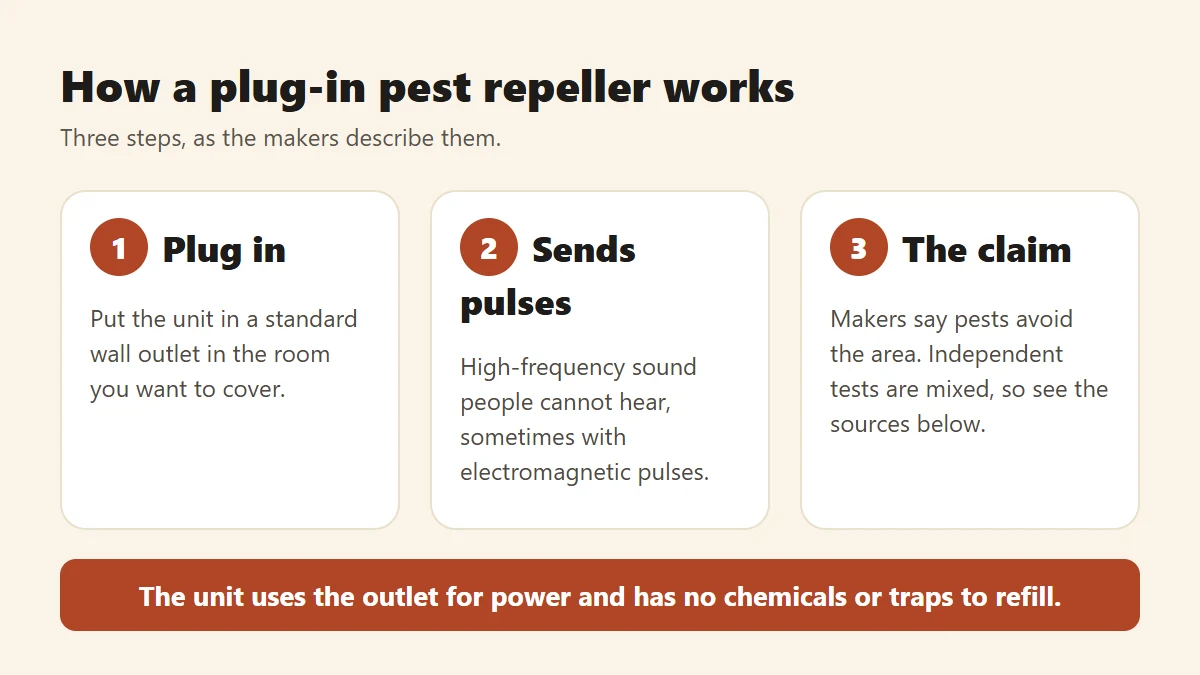
That "getting used to it" point is the part worth understanding. Arizona's publication describes a study on rats and mice in which the animals showed a mild aversion to an ultrasonic sound, and the aversion faded over time, especially once they found a steady food source nearby. Scientists call that habituation. It is the problem the changing-frequency feature is meant to answer, and it is a good question to put to any maker.
What do the EPA and university sources say?
Two things, and both are useful when you shop.
First, the EPA. Devices do not go through a premarket review, and unlike pesticides they do not have to be registered. The EPA says makers and sellers generally do not send it their claims or their efficacy and safety data before selling a device. The establishment number you may see on the box does not mean the EPA reviewed the product for safety or effectiveness. What the rules do require is directions for use on the label and no false or misleading claims, and the maker has to keep the data that supports what it says.
Second, the research. University of Arizona Extension reviewed studies of commercial sonic devices. In the studies it describes, none of three devices repelled ants, nine devices drew no response from German cockroaches and four devices had no effect on bed bugs. It concludes that commercially available sonic devices for homes have not been shown to be effective in scientific studies, and it does not advise them as the way to treat common pest problems. Its shorter 2023 bulletin lands in the same place and points to prevention, direct control and exclusion first.
I read that as a reason to set modest expectations, not as a reason to stop looking. A plug-in repeller is a low-effort extra, and the habits in the next section do the heavy lifting. If you try one, try it where a real money-back guarantee lets you judge it in your own home.
What should you do alongside a repeller?
The Arizona bulletin lists the steps that it says do work, and they cost almost nothing:
- Remove what attracts pests: food, water and nesting material, and keep the area clean.
- Seal cracks and crevices around doors, windows and utilities.
- Store food in pest-proof containers, pet food included.
- Use traps or glue boards inside the house where you see activity, and keep watching to learn whether more is needed.
The gap-sealing step pays you back twice. The same weatherstripping and caulk that close a mouse route also stop drafts, which I cover in my winter home heating checklist and in why one room is always colder.
Which seven checks matter before you pay for one?
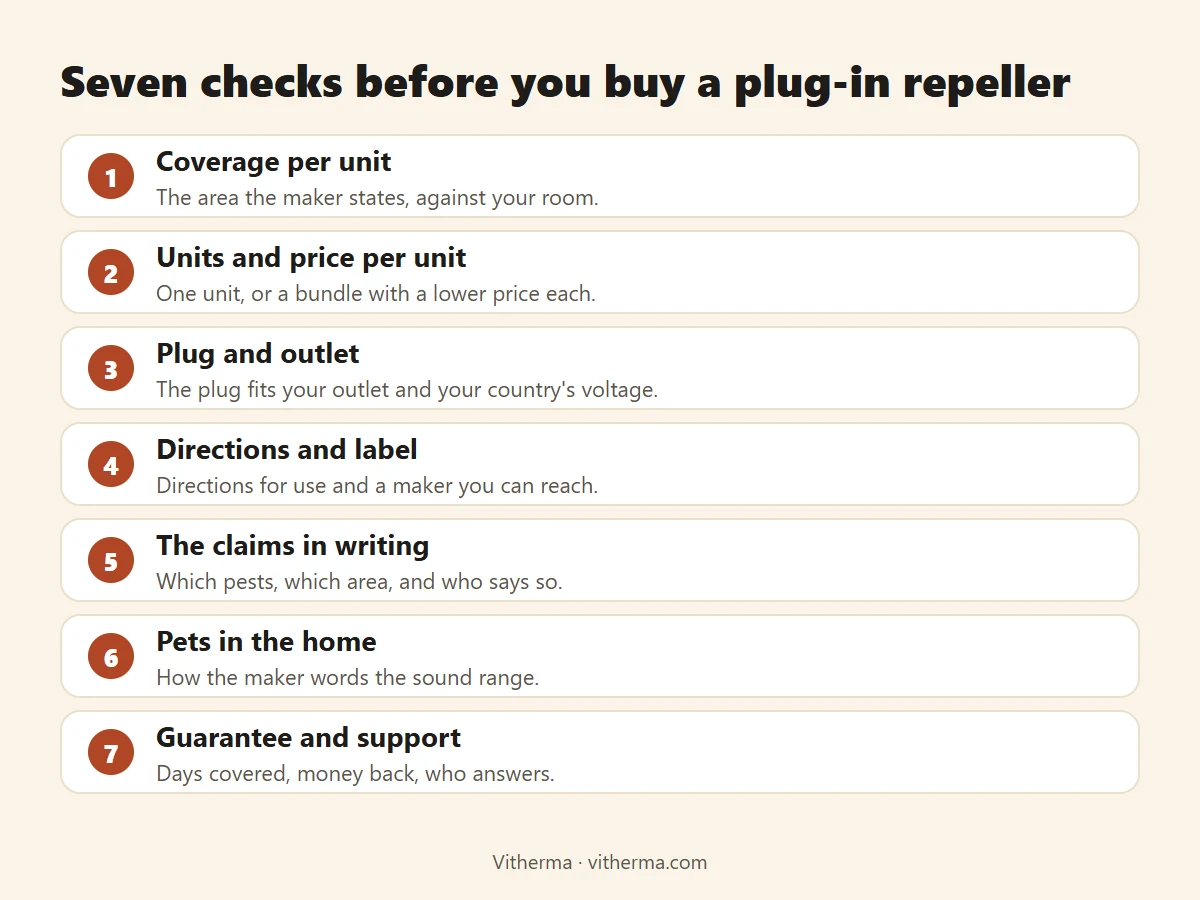
- Coverage per unit. Look for the area the maker states in square feet and compare it with the room you want to cover. A bigger home may need more than one unit.
- Units and price per unit. One unit costs more each than a bundle, so work out how many rooms you will really use before you pick.
- Plug and outlet. Confirm the plug fits your outlet and check the voltage of your wall outlet against the unit before you order.
- Directions and contact. The EPA requires directions for use, so the page or the box should have them, along with a way to reach the maker.
- The claims in writing. Prefer a page that names the pests and the area it covers over one that only says "pest-free". A specific claim gives you something to check.
- Pets in the home. Look at how the maker words the sound range.
- Guarantee and support. How many days you have, whether the money comes back and who answers questions. With a category where results vary, this is the check that protects you most.
Then order from the producer's official website, where the offer on screen is the current one and the guarantee terms are the producer's own.
Where does the PestPulse fit?
Here is how the PestPulse lines up with the checks a product page can answer. It plugs into any standard outlet, it is compact, and the producer states it covers up to 900 sq ft. The producer describes it as silent, with sound undetectable to humans and most household pets, and as safe for children and pets.
On the buying side, every order from the official website has a 30-day money-back guarantee, the producer lists 24/7 customer support and you get a tracking number by email when your order ships. In the United States one unit is $44.95, and the price drops to $19.50 a unit in the ten-pack, which helps if you want a unit in the kitchen, the garage and the basement.
What no product page can tell you is how it performs in your house, and the 30-day guarantee exists for exactly that. The full PestPulse review walks through a typical day with it, lists every bundle price and explains how I scored it.
If you like plug-in gadgets that need no tools, the same outlet questions apply to plug-in wall heaters, and my home and kitchen gadgets guide covers more for the house.
Frequently asked questions
How does a plug-in pest repeller work?
You plug it into a standard outlet and it sends out pulses, usually high-frequency sound people cannot hear and sometimes electromagnetic pulses too. The makers say pests dislike the signal and stay away from the area. The PestPulse producer adds that its frequency patterns change automatically.
Do plug-in pest repellers work?
The makers say they do. The independent sources I read are cautious: the EPA does not review these devices for effectiveness before sale, and University of Arizona Extension found no clear effect in most tests of commercial devices. The sensible way to try one is as an extra next to sealing gaps and storing food, with a money-back guarantee behind it.
Does the EPA approve plug-in pest repellers?
No. The EPA regulates them as devices, which need no premarket review or registration. An establishment number on the packaging does not mean the EPA reviewed the product, but devices must carry directions for use and may not make false or misleading claims.
Are plug-in repellers safe around pets?
The PestPulse producer states its sound is undetectable to humans and most household pets and calls it safe for children and pets.
How many plug-in repellers do I need?
Start from the coverage the maker states. The PestPulse producer says one unit covers up to 900 sq ft, so a small home may need one and a bigger one may need a unit per area where you see pests. Bundles bring the price per unit down.
What else helps keep pests out of the house?
University of Arizona Extension points to removing food, water and nesting material, keeping areas clean, sealing cracks around doors, windows and utilities, storing food and pet food in pest-proof containers, and using traps or glue boards indoors.
How much does the PestPulse cost?
On the official website one PestPulse costs $44.95 in the United States. The price per unit drops to $39.95 for two, $34.95 for three, $28.95 for four, $23.95 for five and $19.50 for ten. The producer can change prices, and the checkout shows the final amount.
What if the PestPulse is not for me?
Every order from the official website carries the producer's 30-day money-back guarantee, whichever bundle you choose, so you can try it in your own home first.
Where can I buy the PestPulse?
On the official PestPulse website, which the buttons on this page link to. Ordering there gets you the producer's own unit, its 30-day guarantee, its customer support and the current bundle prices.