
Short answer
Most adults sleep best in a slightly cool bedroom, around 65 to 68°F (18 to 20°C), with 65°F as the Sleep Foundation’s central figure. A cooler room helps your body temperature drop as you fall asleep. Comfort varies by a few degrees, so start at 66°F, adjust by one or two degrees, and match your bedding to the season.
This article may contain affiliate links, always to the official websites of the products mentioned. If you buy through one of these links, you support my work at no additional cost to you. This never influences what I write.
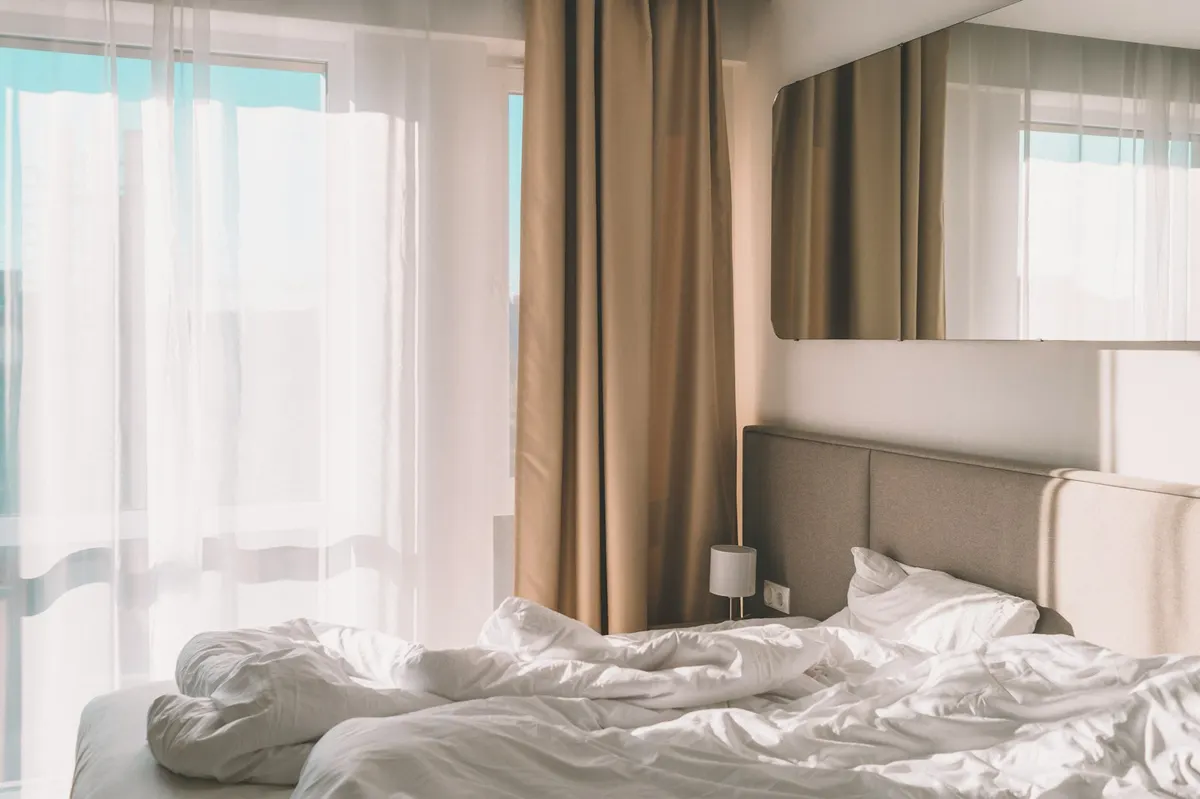
The good news about bedroom temperature is that it is one of the few sleep factors you can change in five minutes, for free, and notice the same night. You do not need a new mattress or a new routine. A few degrees on the thermostat, a lighter duvet and a pillow that lets heat escape can change how quickly you fall asleep and how often you wake up.
This page pulls together what the Sleep Foundation, the CDC and a peer-reviewed review on sleep and body temperature say about the ideal number, then turns it into a simple plan for your own bedroom. Where a figure comes from a study, I name the source next to it.
What is the best bedroom temperature for sleep?
Around 65 to 68°F (18 to 20°C) for most adults. The Sleep Foundation puts the best room temperature at approximately 65°F (18.3°C) and says most doctors recommend a thermostat setting between 65 and 68°F. A wider range, 60 to 68°F, is what sleep experts typically recommend, and the CDC’s sleep advice simply asks for a bedroom that is quiet, relaxing and at a cool temperature. A review in Frontiers in Neuroscience on the temperature dependence of sleep lands in the same place: it describes optimal room temperatures as approximately 19 to 21°C (66 to 70°F).
| Source | What it says | Range |
|---|---|---|
| Sleep Foundation, best temperature for sleep | About 65°F is best; doctors suggest a thermostat setting of 65 to 68°F | 65 to 68°F (18 to 20°C) |
| Sleep Foundation, bedroom temperature | The range sleep experts typically recommend | 60 to 68°F (16 to 20°C) |
| Harding, Franks and Wisden, 2019 | Optimal room temperatures for human sleep | 19 to 21°C (66 to 70°F) |
| CDC, sleep tips | Keep the bedroom quiet, relaxing and at a cool temperature | “Cool”, no number given |
All four point to the same zone: cool, but not cold. If you only change one thing tonight, set the bedroom to about 66°F (19°C) and see how you feel in the morning.
Why does a cooler room help you fall asleep?
Because falling asleep is partly a cooling process. The review in Frontiers in Neuroscience describes sleep onset as coinciding with a fall in core body temperature, and notes that people are most likely to fall asleep when their core temperature is dropping fastest. To make that happen, your body sends warm blood to the hands and feet and lets heat out through the skin. A cool room makes that heat release easier.
The same review gives a useful detail: in optimal room temperatures, people try to build a skin microclimate (the thin layer of air under the covers) between 31 and 35°C. So the target is a cool room and a comfortably warm bed, not a cold bed. That is why bedding matters as much as the thermostat, and why the next two sections cover it.
There is a bonus trick on the same theme. The review reports that a hot bath taken before, but not immediately before, bedtime shortens the time it takes to fall asleep, and the Sleep Foundation suggests a warm bath an hour or two before bed. Your body warms up in the water and then cools off quickly afterward, which gives the natural temperature drop a head start.
What happens when the bedroom is too warm?
You tend to sleep lighter. The Sleep Foundation’s overview links a higher core body temperature with less slow-wave sleep (the deepest stage) and lower sleep quality, and notes that very hot conditions appear to reduce REM sleep. It also cites a study of 50 older adults, published in Science of the Total Environment, in which sleep efficiency fell by 5 to 10 percent when the room reached 86°F (30°C).
The fix is usually small. Close the blinds during the day so the room does not store the sun’s heat, lower the thermostat in the evening, and let a fan move air across the room. The Sleep Foundation lists exactly these steps, along with opening a window when the outside air is cooler and keeping humidity under control.
If summer is the issue, three of my guides cover the cooling side: evaporative cooler vs fan, portable air cooler vs portable AC and the complete guide to portable heaters and coolers, which sizes both by room.
Does the best temperature change with age or season?
A little, yes, and that is a reason to treat the 65 to 68°F range as a starting point instead of a rule.
- Older adults. The Sleep Foundation notes that older adults often have more trouble staying warm, and the 50-person study it cites found sleep got worse when the room fell below 68°F (20°C) or rose above 77°F (25°C). Between those two limits is the sweet spot, so the upper half of the usual range suits many older sleepers.
- Babies. The Sleep Foundation says infants may sleep slightly warmer, up to 69°F (20.5°C), and warns that an overheated room is a concern for sudden infant death syndrome. A paediatrician is the right person to set the number for your baby.
- Winter and summer. The room temperature you need changes with your bedding, as the next section shows. A heavier duvet in winter lets you keep the room cooler without feeling it.
The CDC adds one useful anchor for why this is worth the effort: adults aged 18 to 60 need 7 or more hours of sleep a night. A bedroom that helps you stay asleep is one of the cheapest ways to get there.
How do bedding and pajamas change the number?
A lot. Bedding acts as insulation, and the Sleep Foundation summarises a study in the Journal of Thermal Biology that makes the point clearly: with a thin duvet, comfortable room temperatures ran from 62 to 72°F (17 to 22°C), while with a heavier duvet they ran from 46 to 64°F (8 to 18°C). In that research, participants slept well as long as the microclimate inside the bed stayed between 86 and 91°F (30 to 33°C).
That gives you two ways to hit the same comfort. You can change the room, or you can change what is on the bed. In practice it is easier to change the bed:
- Warm room, light duvet. If you like a room at 68°F or above, a thin cover keeps the bed inside that comfortable microclimate.
- Cooler room, heavier duvet. If you prefer to sleep at 62 to 64°F, a heavier cover does the job.
- Natural fibers and breathable sheets. Cotton, linen and other breathable fabrics let moisture and heat move away from your skin.
- Warm feet. The Sleep Foundation reports that chronically cold feet may be linked to trouble falling asleep, so socks are a legitimate sleep tool on a cool night.
Where the pillow fits in
The pillow is the one piece of bedding that touches your head all night, and the head gives off a good amount of warmth. A pillow with a breathable cover and a surface with channels lets some of that heat escape, which is useful for anyone who warms up during the night. The Derila Ergo is built along those lines: a contoured memory foam pillow with moulded channels and a removable, breathable knit cover that goes in the wash. In my own use the cover felt cool to sleep on, and the butterfly shape gives the shoulder somewhere to go for side sleepers. My side sleeper pillow guide explains how to choose the shape and height.
How do you get your bedroom to the right temperature?
Start from where your room sits today. The right move depends on whether it runs warm, cool or about right.
| If your bedroom… | What helps most | Where to read more |
|---|---|---|
| Runs warm in summer | Blinds closed by day, a fan or cooler at night, a lighter duvet | Evaporative cooler vs fan |
| Is humid and sticky | A portable AC works where a cooler struggles; check the humidity rule first | Air cooler vs portable AC |
| Is chilly on winter evenings | Warm the room before bed with the door closed, then keep a heavier duvet and socks | Portable heater guide |
| Needs a quiet heater for the bedroom | Pick by decibel rating and a thermostat that cycles the heater off | Quiet bedroom heaters |
| Is about right, but you wake up hot | Check the bedding and the pillow before touching the thermostat | Side sleeper pillow guide |
A note for the winter row: the Consumer Product Safety Commission asks that heaters be turned off when you sleep. A simple routine is to warm the bedroom before bed with the door closed, switch the heater off, and let the layers on the bed do the work through the night. My overnight heater guide walks through the routine, and the electricity guide shows what an evening of running one actually costs.
How do you find your own number in five nights?
Use the research range as a starting point and let your own mornings decide. This takes five nights and costs nothing.
- Night 1: set the room to about 66°F (19°C) an hour before bed, with the door closed.
- Keep the bedding and pajamas the same for the first three nights, so only one thing changes at a time.
- Check how you feel on waking. Hot, damp or kicking off the covers means go down one or two degrees or switch to a lighter duvet. Cold hands, cold feet or waking early means go up one or two degrees or add a layer.
- Add the bath. On nights four and five, take a warm bath or shower an hour or two before bed and see whether you fall asleep faster.
- Write down the winner. The setting you keep for most of the season is your number, and it is allowed to be a degree or two outside the textbook range.
If you only remember one line: keep the room cool, keep the bed comfortably warm, and let your own mornings tell you the exact number.
Frequently asked questions
What is the best temperature for sleeping?
For most adults, about 65 to 68°F (18 to 20°C). The Sleep Foundation names approximately 65°F as the best bedroom temperature and says most doctors recommend a thermostat setting between 65 and 68°F. Personal comfort moves that by a few degrees either way.
Is 60°F too cold to sleep in?
Not necessarily. The Sleep Foundation says sleep experts typically recommend 60 to 68°F, so 60°F sits at the cool edge of the usual range. With a heavier duvet and warm feet many people sleep well there, and if you wake up cold, a degree or two higher or an extra layer is the simple fix.
Is 72°F too warm for sleep?
It is above the usual 65 to 68°F range, but not out of bounds. In the study the Sleep Foundation summarises from the Journal of Thermal Biology, comfortable room temperatures with a thin duvet reached 72°F. Try a lighter cover and a fan before turning the thermostat down.
What is the best bedroom temperature for older adults?
Slightly warmer than the general range may suit them. The Sleep Foundation cites a study of 50 older adults in which sleep got worse when the room fell below 68°F or rose above 77°F, and notes that older adults often have more trouble staying warm. Aim for the 68°F end and adjust with bedding.
What temperature should a baby's room be?
The Sleep Foundation says infants may sleep slightly warmer than adults, up to 69°F (20.5°C), and that an overheated room is a concern for sudden infant death syndrome. Ask your paediatrician for the number and the sleepwear that fits your baby.
Does a cooler room really help you fall asleep faster?
It supports the way your body already prepares for sleep. A review in Frontiers in Neuroscience describes sleep onset as coinciding with a fall in core body temperature, and a cool room makes it easier for the body to release heat. A warm bath an hour or two before bed also helps by speeding that cooldown.
Can I use a space heater to warm my bedroom before bed?
Yes, as part of a routine. The Consumer Product Safety Commission asks that you turn heaters off when sleeping, so warm the room with the door closed, switch the heater off and rely on bedding through the night. Keep it plugged directly into a wall outlet and at least 3 feet from drapes and bedding.
Is this medical advice?
No. I research home products; I am not a doctor or a sleep clinician. This guide is about comfort and the home environment. If you have trouble sleeping most nights, loud snoring, or heavy daytime sleepiness, please talk to a qualified clinician.
Sources
- Sleep Foundation: best temperature for sleep
- Sleep Foundation: bedroom temperature
- Harding, Franks and Wisden, The Temperature Dependence of Sleep, Frontiers in Neuroscience, 2019
- CDC: about sleep and tips for better sleep
- U.S. Consumer Product Safety Commission: winter safety tips for generators, furnaces and space heaters