
Short answer
Side sleepers get relief by keeping the neck level and the shoulder unsqueezed. That means a pillow that fills the gap between head and mattress without propping the head up, a pillow between the knees, support under the top arm and, with one sore shoulder, not lying on it. A contoured pillow adds shoulder room. Pain that lingers deserves a clinician.
This article may contain affiliate links, always to the official websites of the products mentioned. If you buy through one of these links, you support my work at no additional cost to you. This never influences what I write.

If you sleep on your side and wake up with a stiff neck or an aching shoulder, you are not imagining that the night did it. Lying on your side changes how your head, neck and shoulder line up, and a small mismatch is enough to feel by morning.
The encouraging part is that side sleeping itself is a good position for most necks. What usually needs fixing is the setup around it: the height of the pillow, the room your shoulder has, and where your top arm ends up. This guide separates what the medical and sleep sources support from what pillow marketing says. Where a fact comes from Harvard Health, Cleveland Clinic or the Sleep Foundation, I name the source next to it. I research home products; I am not a doctor, and the last sections cover when to take the pain to one.
Why do side sleepers wake up with neck and shoulder pain?
Because two different things happen at once. Your neck is holding your head at a height set by the pillow, and your shoulder is carrying your body weight against the mattress. Each can go wrong on its own.
The Sleep Foundation explains the geometry plainly. On your side, your shoulders raise your head off the bed, so the pillow has to fill the space between your head and the mattress, and side sleepers usually do best with a thicker pillow than back sleepers. It also notes that the shoulders and hips bear the brunt of your weight where you meet the mattress, which is why a supportive pillow and a mattress that evenly spreads your weight both matter.
Height matters in both directions. Harvard Health warns against pillows that are too high or too stiff, because they keep the neck flexed overnight and can leave you with morning pain and stiffness. Cleveland Clinic describes the other side of the same coin: for side sleeping, the pillow should be thick enough to support your head and neck without letting your head droop.

That gives you a simple way to read your morning. Use it as a rule of thumb, not a diagnosis.
| What you feel on waking | Most likely setup issue | First thing to try |
|---|---|---|
| Stiff neck, head feels tilted | Pillow height does not match the gap between head and mattress | Re-check the height with the front-view photo check below |
| Ache in the shoulder you lie on | Pressure from body weight, or no room for the shoulder | Give the shoulder room and check the mattress |
| Ache in the top shoulder | The top arm drops forward and pulls on the shoulder | Rest that arm on a pillow |
| Numb or tingling arm | Shoulder squashed with nowhere to go, or something else | Free the shoulder, and mention it to a clinician if it repeats |
Is sleeping on your side bad for your neck?
No, and that is the good news. The Sleep Foundation notes that research suggests side sleeping, particularly symmetrical side lying, can reduce pain in the back and neck, and that a supportive pillow plays an important role in preventing neck pain. Harvard Health goes further and names side and back as the two easiest positions for the neck, with stomach sleeping the hardest, because the back is arched and the neck is turned to the side for hours.
“Symmetrical” is the useful word there. It means your arms and hands stay roughly in line with each other and your neck and torso stay neutral, instead of one shoulder rolling forward or your head twisting toward the mattress. A good side-sleeping setup is mostly about getting close to that shape.
How can you tell if your pillow height is the problem?
Do a two-minute check you can repeat any night. Lie on your side in your usual position and ask someone to look at you from the front, or prop your phone on the nightstand and take a photo. Three things should be true:
- Your head is level, not tilted up or sagging down. The line of your neck should carry on the line of your spine with no visible kink at the shoulder.
- You are looking forward. Cleveland Clinic advises sleeping looking forward to keep the natural curve of your neck, and not tucking your chin.
- The pillow is not pushing your head higher than your spine. Harvard Health puts it as keeping your spine straight with a pillow that is higher under your neck than under your head.
If the photo shows a tilt, height is your first suspect. If your head looks level and the shoulder still hurts, the next place to look is the shoulder itself, which is the next section.
What can you change tonight without buying anything?
Quite a lot. These four changes cost nothing, and they come straight from the sources above.
- Put a pillow between your knees. The Sleep Foundation suggests a small pillow or a rolled-up towel to relieve pressure on the hips. Cleveland Clinic adds that it stops your upper leg pulling forward and twisting your torso, which keeps hips and spine aligned.
- Support the top arm. If the sore shoulder is on top, Cleveland Clinic suggests pillows that hold that arm straight and neutral. A physical therapist quoted in its rotator cuff article describes a pillow wall in front of you, about body height, to rest the arm on.
- Do not lie on the sore shoulder. The Sleep Foundation’s rule of thumb for one painful shoulder is to avoid lying on the affected side. Cleveland Clinic gives the same direction: sleep with the injured shoulder up.
- Stay off your stomach. Harvard Health calls stomach sleeping tough on the spine, and Cleveland Clinic advises against it when a shoulder hurts, because it can increase the pain.
One more lever is the mattress. The Sleep Foundation says side sleepers generally feel more comfortable on softer mattresses, since a softer surface cushions the shoulders and hips, and recommends a medium or medium-firm mattress for side sleepers. If your shoulder cannot sink in at all, the pillow can only do so much.
When does a contoured pillow beat an ordinary pillow?
When the shoulder is the part that has nowhere to go. An ordinary pillow is the same height everywhere, so your shoulder has to push up against its edge. A butterfly-shaped contour pillow changes shape across the surface: a dip for the head, a raised edge or lip for the neck, and a cut-away at the sides where the shoulder fits. My side sleeper pillow guide explains how loft and the shoulder gap work in more detail.
It is not the right answer to every pain, so here is the honest side-by-side.
| Ordinary pillow | Butterfly contour pillow | |
|---|---|---|
| Room for the shoulder | None; the shoulder meets the edge | A cut-away or arch made for it |
| Support under the neck | Depends on loft; can leave a gap | A raised lip that fills the gap |
| Height | Often adjustable if it is filled with fiber or feathers | Fixed by the moulding, so it has to suit you |
| First nights | Feels familiar | A few nights to settle in |
| Best for | Any position, including stomach | Side and back sleepers who feel the shoulder getting squashed |
Two honest notes. A pillow does not replace a mattress that is wrong for you, and it does not treat a shoulder problem; it only makes the night easier on the neck and shoulder. And a fixed shape is a feature when the height suits you, which is why a trial period matters more on this kind of pillow than on any other.
How do the Derila Ergo and the Melara Pillow handle the shoulder gap?
They solve the same problem in the same way: a butterfly-shaped memory foam pillow with a place for the shoulder and support for the neck. The differences are in the details. I wrote a full review of each, the Derila Ergo review and the Melara Pillow review, if you want every spec and the price packs.
| Derila Ergo | Melara Pillow | |
|---|---|---|
| Shape | Raised wings, a dipped centre for the head, a lip under the neck | Front support wings, a shoulder arch, a lowered central core, wide arm-rest tips |
| Core | High-density memory foam | Memory foam |
| Size | Compact, smaller than a standard pillow | 62 x 36.9 cm (24.4 x 14.5 in) |
| Cover | Breathable knit, removable and machine-washable | Breathable design; follows the care label |
| Positions listed | Side and back | Side, back and stomach, plus naps |
| Trial | 30-night money-back trial | 30-night satisfaction guarantee |
| How I know it | I have slept on it | Published specs and buyer reports; I have not tested it |
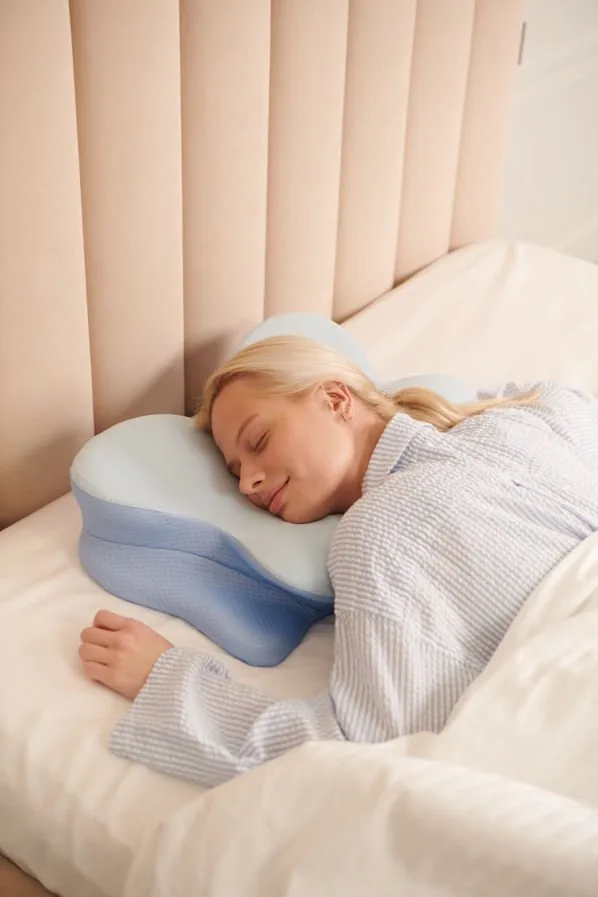

Neither one is a treatment, and neither claims to be. They are comfort equipment that gives the shoulder somewhere to go, and that is exactly the part an ordinary pillow cannot do.
Which one fits you?
The shape is the same, so the choice comes down to what you care about most. Here is the simple version.
| If you… | Look at | Why |
|---|---|---|
| Want a cover you can throw in the wash | Derila Ergo | The knit cover is removable and machine-washable |
| Want the pillow I have actually slept on | Derila Ergo | My review is based on using it, not only on specs |
| Start the night on your back and wake up on your side | Melara Pillow | It lists side, back and stomach sleeping, with a zone for each |
| Fall asleep with headphones on | Melara Pillow | The lowered central core leaves room for them |
| Hug the pillow or rest an arm on it | Melara Pillow | Its wide wing tips are made as an arm rest |
| Mainly want a place for the shoulder to sit | Either | Both are built around that gap, and both give you 30 nights to decide |
Whichever you choose, give it a week before deciding. A contour changes where your head sits, so it can feel strange before it feels right, and a few nights of adjustment is normal with both.
When is neck or shoulder pain more than a pillow problem?
A better setup can take the strain out of a night, but some pain deserves a professional look. Cleveland Clinic lists shoulder pain that gets worse at night among the signs of a possible rotator cuff tear, together with trouble raising the arm, popping or clicking in the shoulder and overall weakness. The same article notes that the cause of that night pain is not fully understood, and that you should check with your doctor before taking pain medication.
My own rule of thumb, from someone who is not a clinician, is to take it to a doctor or physical therapist when any of these is true:
- The pain lasts through the day, not only on waking.
- It has not eased after a couple of weeks of sensible changes.
- Your arm or hand goes numb or tingles, and it keeps coming back.
- You notice weakness, or the pain started after a fall or an injury.
A pillow is comfort equipment. It is a good place to start, and a clinician is the right person when the pain keeps asking for more.
How do you test a change in seven nights?
Change one thing at a time and let your mornings give the verdict. It takes a week and costs nothing.
- Night 1: write down your baseline. Rate your neck and your shoulder from 0 to 10 when you wake, before you change anything.
- Nights 2 and 3: free fixes. Add the pillow between your knees and support under the top arm. Do the front-view photo check on your current pillow.
- Nights 4 to 7: change the pillow, if the photo showed a tilt or the shoulder still has no room. If you try a contour pillow, give it the full four nights before judging, and keep the receipt for the trial window.
- Every morning: write the two numbers. A steady drop is your answer; no change after a week means a conversation with a professional is next.
If you also wake up hot and keep turning over, my guide to the best bedroom temperature for sleep covers the other half of a good night.
Photos: Miriam Alonso and Ba Tik on Pexels; product photos by the producers.
Frequently asked questions
What is the best sleeping position for neck pain?
Side or back. Harvard Health names side and back as the two easiest positions for the neck and stomach sleeping as the hardest, because the back is arched and the neck is turned to the side. The Sleep Foundation adds that side sleeping, particularly symmetrical side lying, can reduce neck pain with a supportive pillow.
Should you sleep on the sore shoulder?
Avoid it if you can. The Sleep Foundation’s rule of thumb for one painful shoulder is not to lie on the affected side, and Cleveland Clinic advises side sleepers to sleep with the injured shoulder up, resting the arm on a pillow in front of them.
How thick should a side sleeper’s pillow be?
Thick enough to fill the space between your head and the mattress without lifting your head above your spine. The Sleep Foundation notes that shoulders raise the head off the bed, so side sleepers usually do best with a thicker pillow, and Harvard Health warns that one that is too high or stiff keeps the neck flexed overnight. There is no single number, so use the front-view photo check.
Does a pillow between the knees help neck pain?
Indirectly. Cleveland Clinic says a pillow between your legs stops your upper leg pulling forward and twisting your torso, and the Sleep Foundation says it relieves pressure on the hips. Keeping the hips and torso steady makes it easier for the spine, and so the neck, to stay in line.
How long does it take to get used to a contoured pillow?
A few nights is normal. A contour changes where your head sits, so it can feel strange before it feels right. Both the Derila Ergo and the Melara Pillow come with a 30-night trial, which is long enough to give it a full week and then decide.
Is memory foam better than feather for a stiff neck?
Either can work. Harvard Health notes that feather pillows conform to the neck but flatten over time and should be replaced about yearly, and lists memory foam, including cervical designs, as another option. The shape and height matter more than the filling.
Is this medical advice?
No. I research home products; I am not a doctor or a physical therapist. This guide is about comfort and the sleeping setup. If you have persistent neck or shoulder pain, numbness, weakness or pain after an injury, please see a qualified clinician.